
Every few years, the future of digital marketing shaped by evolving digital marketing trends 2026 reaches an inflection point — a moment when the old playbook shaped by outdated digital marketing trends 2026 stops working and a new strategy influenced by the future of digital marketing 2026 has to be written. 2026 is one of those moments.
The future of digital marketing in 2026 is being shaped by a combination of forces that have never converged like this before: AI in digital marketing 2026 reaching mainstream adoption, Google’s continued shift toward AI-generated search overviews, the collapse of third-party cookies, and a consumers reacting to rapidly changing digital marketing trends and fragmented platforms. Businesses ignoring emerging digital marketing trends in 2026 will lose ground quickly.
This article breaks down exactly where the future of digital marketing is heading, what is driving those changes, and what brands and marketers need to do to stay competitive. Whether you are running an in-house team or working with a digital marketing partner like Hawkeye Marketing, the frameworks here will help you allocate effort across the best digital marketing strategies for 2026 using the best digital marketing strategies for long-term growth.
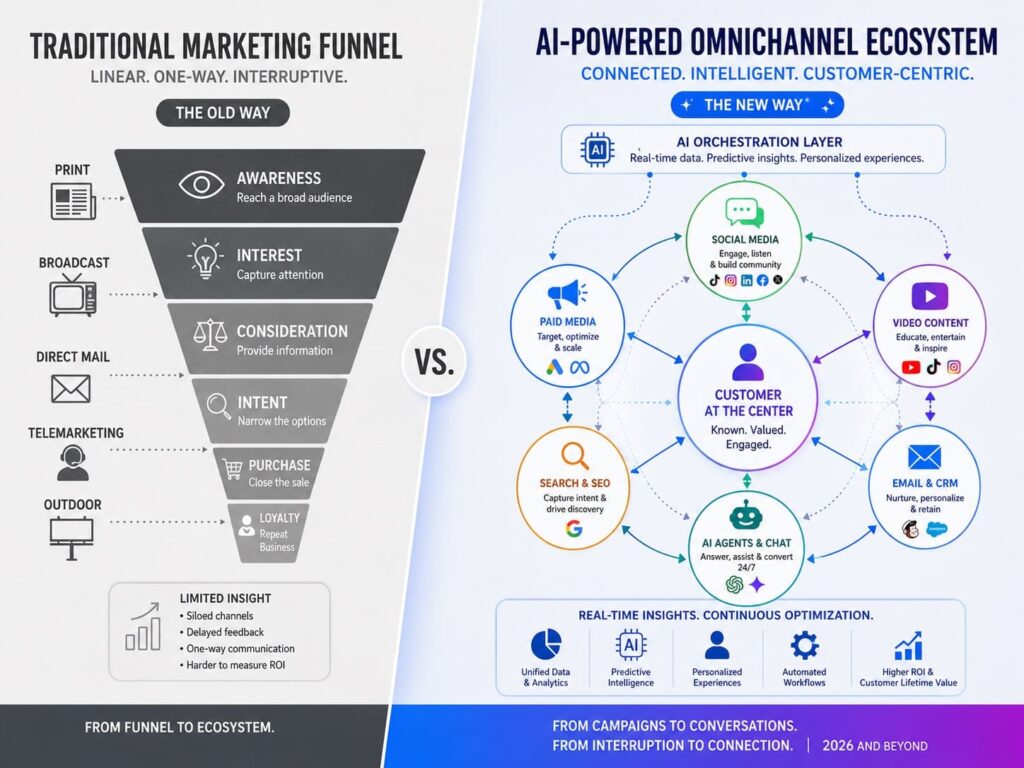
Table of Contents
ToggleIntroduction to the Future of Digital Marketing
The future of digital marketing as a discipline has always evolved in response to platform shifts driven by digital marketing predictions 2026, and changing consumer behavior in personalization in digital marketing in the future of digital marketing 2026 driven by evolving digital marketing trends. What is different about 2026 is the velocity of digital marketing trends 2026 happening simultaneously.
AI in digital marketing has moved from experimental to operational in the span of eighteen months. Google has restructured search through AI in digital marketing 2026 around AI-generated summaries. Short-form video and modern social media marketing trends have made attention spans shorter due to evolving social media marketing trends 2026 but intent signals more concentrated. The death of the third-party cookie — long predicted, repeatedly delayed — is now effectively complete.
These are not isolated trends. They are interconnected shifts that require marketers to rethink assumptions about traffic, conversion, audience ownership, and content production. The brands adapting fastest to new digital marketing trends are not necessarily the biggest ones.
Why 2026 Marks a Revolutionary Turning Point in Digital Marketing Trends
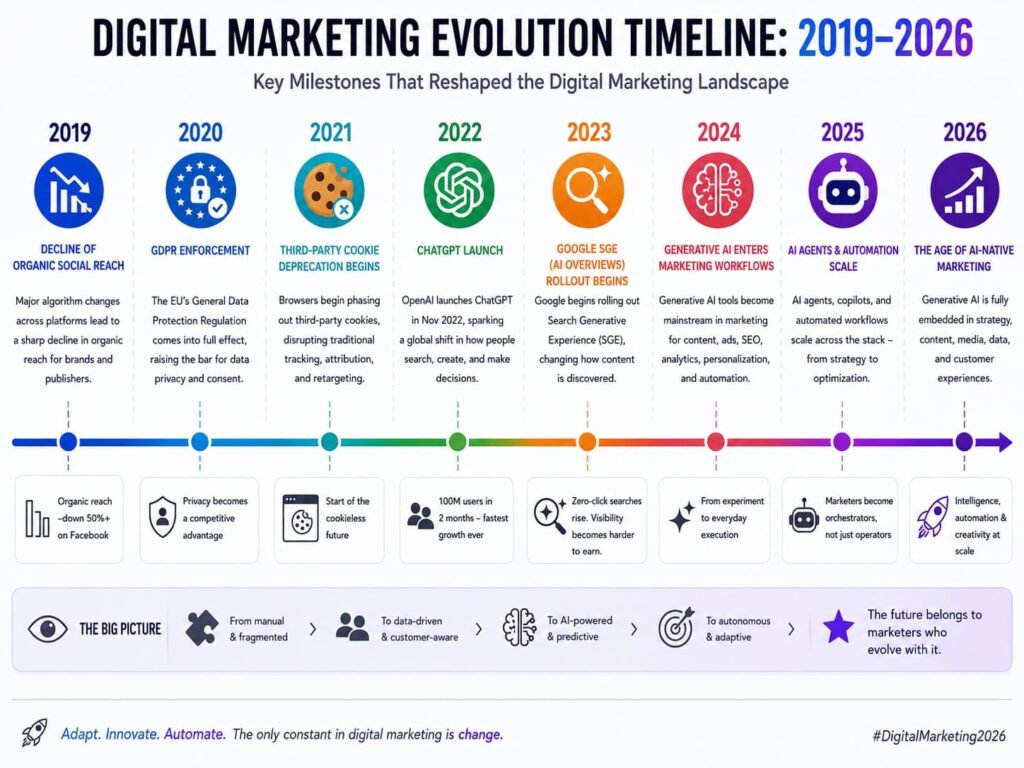
To understand where digital marketing is going in 2026, you need to understand what collapsed in the years leading up to it — and why the future of digital marketing is being shaped by these changes.
Current social media marketing trends show organic reach has been declining since 2019. The average organic post on Facebook reaches less than 5% of a page’s followers. Instagram prioritizes Reels over static posts. LinkedIn is increasingly competitive. Meanwhile, digital marketing predictions indicate paid media costs will continue rising steadily.
At the same time, what is the future of SEO has become more complex. Google’s algorithm updates are reshaping what is the future of SEO— including the Helpful Content System — have deprioritized thin, keyword-stuffed content in favor of authoritative content aligned with what is the future of SEO in 2026. This is E-E-A-T (Experience, Expertise, Authoritativeness, Trustworthiness) in practice, and brands that were building content factories instead of genuine expertise are now paying the price in ranking losses.
In 2026, these pressures are reaching a critical threshold. Brands can no longer paper over weak strategy with budget. Despite evolving digital marketing trends, the fundamentals matter more than ever.
The Role of AI in Digital Marketing — What Has Actually Changed
AI Application | Marketing Function | Impact Level |
Generative content writing | Blog posts, ad copy, email sequences | High |
Predictive audience segmentation | Paid media targeting | High |
Automated A/B testing | CRO and email optimization | Medium-High |
AI in digital marketing 2026 through AI-powered chatbots | Lead capture and support | Medium |
Sentiment analysis | Brand monitoring and social listening | Medium |
Dynamic creative optimization | Display and video advertising | High |
AI-driven SEO tools | Keyword clustering and content planning | Medium-High |
Teams investing in AI in digital marketing are seeing the highest returns. They are using it to raise the output ceiling —producing more content iterations through the growing role of AI in content marketing, testing more variables, and personalizing at a level that was previously only possible for enterprise brands with large budgets.
The role of AI in content marketing cannot replace is strategic judgment required for the best digital marketing strategies for 2026, brand voice, and the ability to build genuine relationships with an audience. The marketers who treat AI as a replacement for thinking are producing content that reads like everyone else’s. The marketers using AI as a force multiplier on original ideas are pulling ahead.
What is the Future of SEO in 2026? Surviving the Search Generative Experience
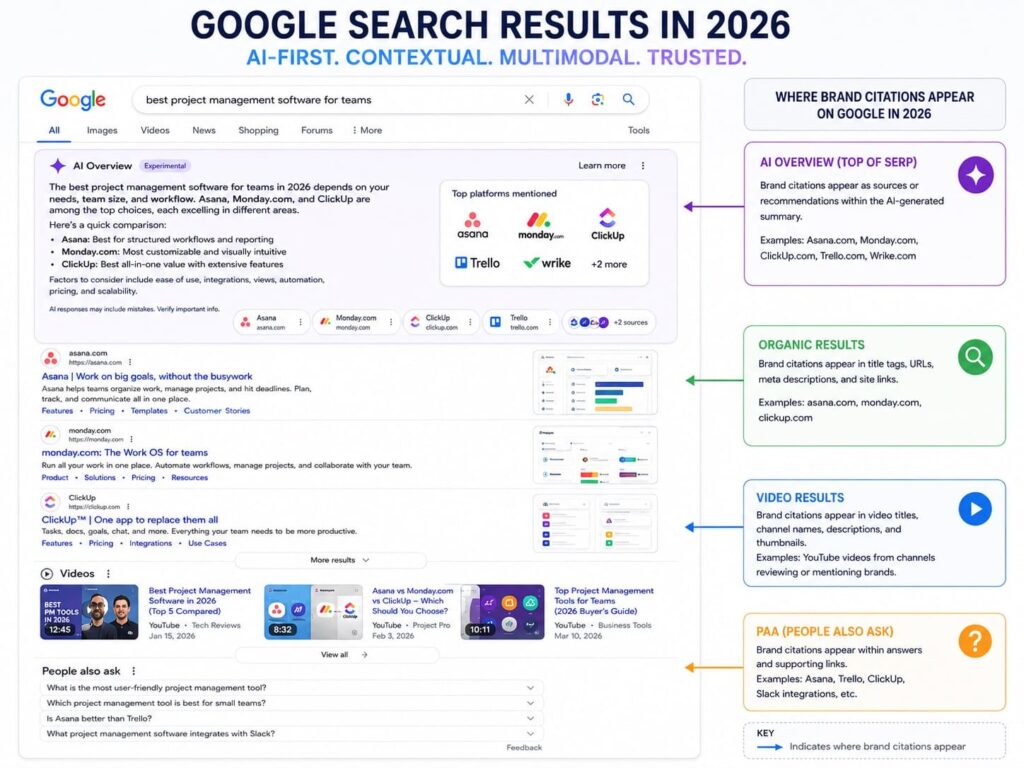
Google’s Search Generative Experience is reshaping the future of digital marketing 2026 the economics shaped by digital marketing predictions 2026. Historically, ranking strategies in older digital marketing trends 2026 meant traffic. Now, a significant share of queries are answered directly in the AI overview, with no click required.
This shift does not mean SEO in 2026 is dead; it shows how the future of digital marketing is becoming AI-first. It means the role of SEO in 2026 has expanded from ranking to being cited. Brands that are referenced inside AI overviews receive brand exposure even without clicks. Over time, being cited in AI-powered digital marketing trends 2026 builds the kind of authority that also drives branded trust influenced by digital marketing trends 2026.
Generative AI has moved from experimental to operational in the span of eighteen months. Google has restructured its search results around AI-generated summaries. social media marketing trends 2026 have made attention spans shorter but intent signals more concentrated. The death of the third-party cookie — long predicted, repeatedly delayed — is now effectively complete.
These are not isolated trends. They are interconnected shifts that require marketers to rethink assumptions based on digital marketing predictions 2026, conversion, audience ownership, and content production. The brands adapting fastest are not necessarily the biggest ones — they are the most agile enough for the future of digital marketing 2026.
What SEO Looks Like in Practice in 2026
- Topical authority over individual keyword targeting — build content ecosystems, not isolated articles
- Structured, answerable content that directly addresses questions AI systems can extract and cite
- Technical foundations required in what is the future of SEO in 2026 remains critical in SEO in 2026: page speed, crawlability, and schema markup remain foundational
- Entity-rich writing that connects your brand to established industry concepts, people, and organizations
- E-E-A-T signals: author credentials, original research, case studies, and real-world experience
Social Media Marketing Trends in 2026
Current social media marketing trends show that social media in 2026 is no longer just one channel — it is a fragmented ecosystem shaped by social media marketing trends 2026, each with distinct audience expectations, algorithm logic, and content formats. The brands performing best understand how will digital marketing change and focus only on high-impact platforms. They are choosing channels based on the best digital marketing strategies for 2026 where their audience is most active and going deep.
Platform-Specific Context
Platform | Primary Format | Audience Trend | Best Use Case |
TikTok | Short-form video | Expanding beyond Gen Z to 35-54 | Brand awareness, product discovery |
Reels + Stories | Stable, visual-first audiences | Lifestyle, e-commerce, community | |
Long-form text + video | B2B decision-makers | Thought leadership, B2B lead gen | |
YouTube | Long-form + Shorts | Cross-generational, search-driven | Education, reviews, product demos |
Visual search | High purchase intent users | E-commerce, home, fashion, food | |
X (Twitter) | Text, news, commentary | Shrinking but high-intent niches | Real-time engagement, PR |
The most significant shift in social media marketing in 2026 is the rise of creator partnerships influenced by social media marketing trends 2026. Brand-owned social pages have declining reach. Creator accounts — even micro-influencers with 10,000 to 50,000 followers — regularly outperform brand pages because the algorithm rewards genuine engagement over branded content.
Brands are increasingly structuring influencer relationships as ongoing influencer collaborations aligned with digital marketing predictions 2026. This builds audience familiarity, allows for authentic content evolution, and produces better conversion data over time.
First-Party Data and the Post-Cookie Reality
The deprecation of third-party cookies in Chrome, combined with Apple’s App Tracking Transparency changes, has altered audience targeting in the future of digital marketing 2026 across the web. Retargeting as it existed in 2020 is largely gone for businesses that did not adapt their data infrastructure.
The brands leading the future of digital marketing anticipated this shift by building first-party data assets: email lists, loyalty programs, customer accounts, and zero-party data collection through surveys and preference centers. In 2026, these assets are among the most valuable assets in modern first-party data marketing.
How to Build First-Party Data Assets
- Build value exchange strategies for the best digital marketing strategies for 2026 — give users a reason to share their information (exclusive content, early access, personalized recommendations)
- Build email list segmentation from day one — do not treat your list as one audience
- Invest in a Customer Data Platform (CDP) to unify data across channels and touchpoints
- Use gated content, quizzes, and interactive tools that capture intent data alongside contact information
- Make data privacy compliance part of your brand story — transparency builds trust and opt-in rates
Short-Form Video: Still the Dominant Format
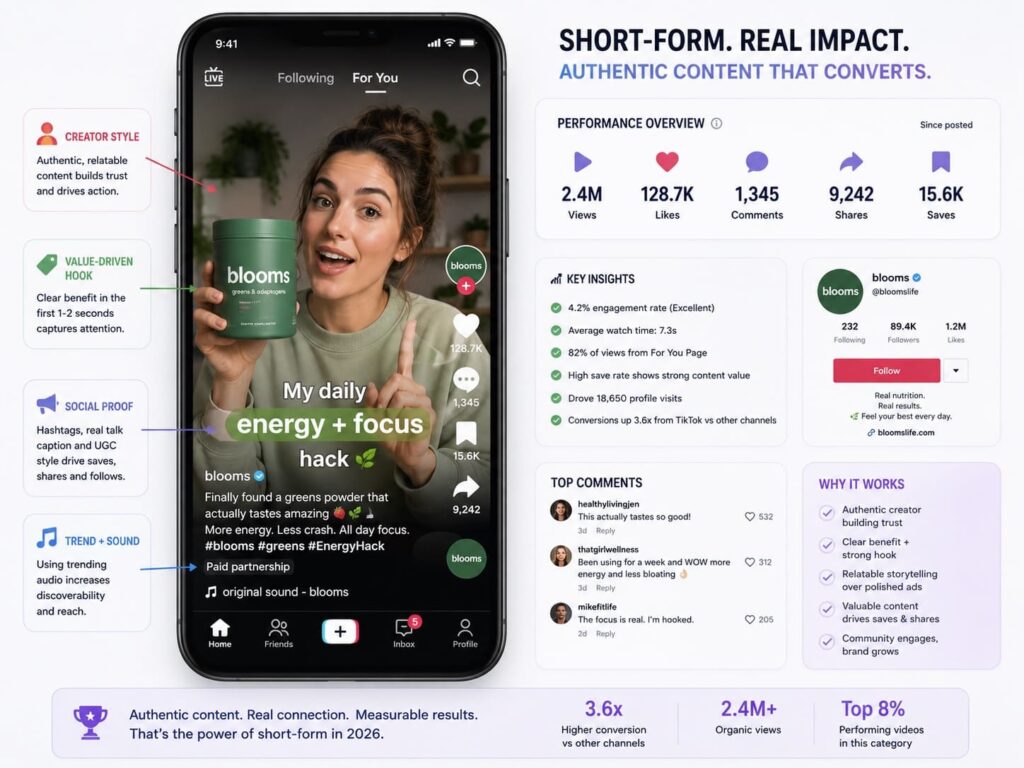
One of the biggest digital marketing trends shaping 2026 is the continued dominance of short-form video. In 2026, it remains dominant — but the bar for what performs has risen significantly. The early-adopter advantage is gone. Every brand has a Reels strategy. Differentiation now comes from production quality, creative originality, and how well the content fits the specific platform’s culture.
According to HubSpot’s 2025 State of Marketing report, short-form video delivers the highest ROI of any content format for the third consecutive year, with 56% of marketers planning to increase their video investment in 2026.
What Makes Short-Form Video Work in 2026
- The first two seconds have to stop the scroll — hook before context
- Native-feeling content outperforms polished brand video — authenticity is the production value
- Captions are mandatory — most video is watched without sound
- Platform-specific formats matter: a TikTok that works verbatim on Instagram Reels rarely performs at the same level
- Calls-to-action need to be friction-free — link in bio is losing to in-video CTAs and native shopping features
Personalization at Scale
Personalization is now one of the most important best digital marketing strategies for modern brands. A McKinsey study found that 76% of consumers are frustrated when brands do not deliver a personalized experience — and 71% expect it as a standard.
In 2026, personalization operates at multiple levels simultaneously: dynamic landing pages that adjust based on traffic source, email sequences that adapt based on engagement behavior, ad creative that rotates based on audience segment, and website content that changes based on visitor history.
The technology to do this exists and is accessible to businesses of all sizes. The bottleneck is not the tool — it is the strategic framework. You need to know what signals matter, what variations to test, and how to measure personalization impact independently of other variables.
Personalization Layers to Implement
- Audience segmentation by intent stage — awareness vs. consideration vs. decision
- Behavioral email triggers — abandoned cart, content engagement, purchase milestones
- Dynamic ad creative — different messaging for new vs. returning visitors, warm vs. cold audiences
- Geo-personalization — localizing content, offers, and case studies by region or city
- Predictive product recommendations — particularly relevant for e-commerce and SaaS
Common Mistakes Marketers Are Making Right Now
The rapid evolution of the future of digital marketing creates specific failure modes for brands. These are the ones appearing most frequently in 2026.
Mistake | Why It Hurts | What to Do Instead |
Publishing AI content without editorial oversight | Thin, generic content that fails E-E-A-T signals and ranks poorly | Use AI for drafts; add human expertise, original examples, and data |
Treating social media reach as a business metric | Reach is vanity; it does not pay bills or fill pipelines | The best digital marketing strategies focus on conversion, email captures, and community engagement |
Ignoring first-party data collection | Leaves the business exposed to platform algorithm changes | Build email and CRM assets that you own outright |
Spreading budget across too many channels | Dilutes effort and produces mediocre results everywhere | Concentrate on two to three channels where your audience is densest |
Optimizing for clicks instead of qualified intent | Traffic that does not convert wastes budget and distorts analytics | Align content and ads to intent stages; measure down-funnel outcomes |
Skipping technical SEO | Fast-moving teams adapting poorly to SEO in 2026 often neglect crawlability and structure | Build SEO audits into your quarterly content calendar |
Best Digital Marketing Strategies for 2026
Build Around Audience Ownership
Every channel you use that you do not control is a liability. Algorithm changes, platform shutdowns, and policy updates can wipe out years of audience-building overnight. Email lists, SMS subscribers, and community platforms you control are the assets that survive those disruptions.
Invest in Content Depth, Not Content Volume
The era of publishing twenty blog posts a month and waiting for traffic is over. Google’s Helpful Content System actively demotes low-quality content, and AI search overviews pull from authoritative, in-depth sources. Ten genuinely excellent pieces of content will outperform one hundred thin ones every time.
Measure the Full Funnel Across Modern Digital Marketing Trends
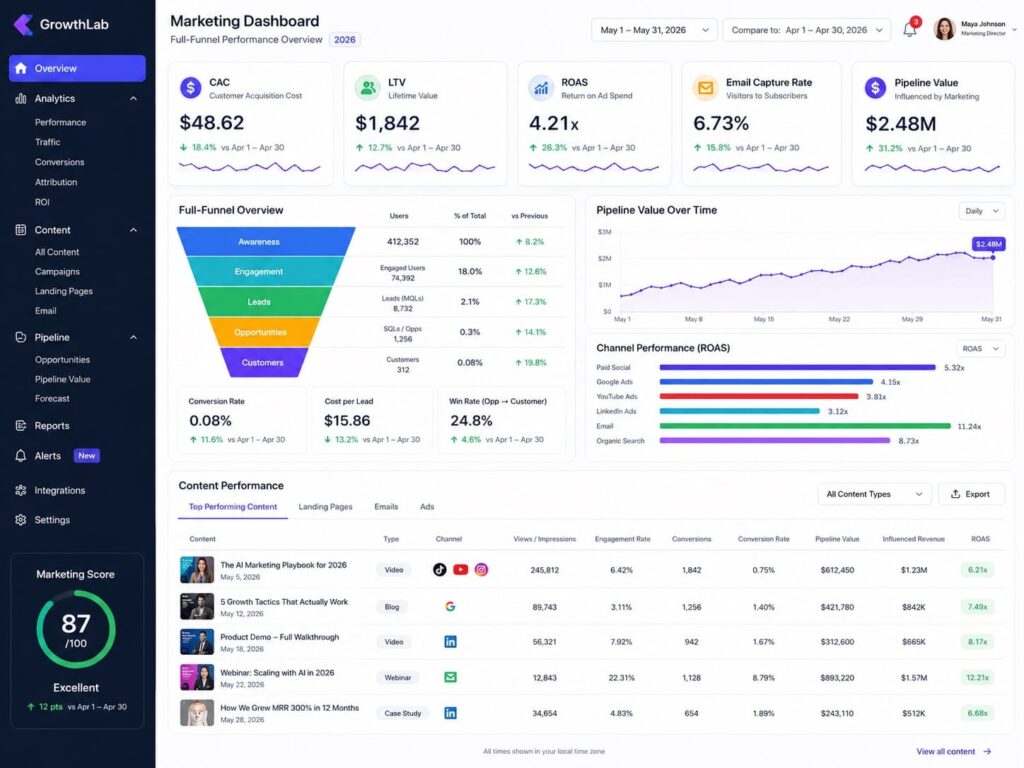
Vanity metrics — impressions, followers, likes — have limited strategic value. The metrics that drive decisions in 2026 are pipeline contribution, customer acquisition cost (CAC), lifetime value (LTV), and return on ad spend (ROAS) at the channel and campaign level.
Test at the Creative Level
Most marketing waste happens because teams commit budget to a single creative approach without testing variations. In 2026, A/B testing should be a workflow standard, not a special project. AI tools make it faster to generate variants; systematic testing turns that speed into insight.
Align SEO and Content Strategy
Content that is not findable does not deliver ROI. Equally, keywords without content strategy produce rankings that do not convert. The brands winning in organic in 2026 are building topical authority — owning entire subject areas with clusters of interlocking content that signals expertise to both humans and AI systems.
Digital Marketing Predictions for the Next Generation of Consumer Behavior
Digital marketing predictions for the next few years suggest consumers will become increasingly selective about the content they engage with online. Audiences are already overwhelmed by repetitive messaging, AI-generated noise, and constant advertising interruptions. As a result, trust is becoming one of the most valuable marketing assets a business can build. Brands that communicate clearly, publish original insights, and maintain consistent experiences across channels will outperform competitors focused only on reach. Another major shift is the growing importance of intent-based marketing, where businesses optimize around customer needs rather than platform algorithms alone. Predictive analytics, behavioral segmentation, and contextual targeting will continue expanding as brands search for better ways to personalize communication without appearing invasive.
Digital Marketing Predictions: What to Watch Through 2027
The next eighteen months will see several developments that are already in motion reach full commercial maturity.
AI Agents in Marketing Workflows
Agentic AI — systems that can plan, execute, and iterate on multi-step tasks without constant human input — is moving into marketing operations. Early implementations are handling email sequence generation, social scheduling, and SEO audits autonomously. By 2027, it is reasonable to expect AI agents managing significant portions of routine campaign management.
Spatial and Immersive Commerce
Apple Vision Pro and competing devices have seeded a new category of immersive product experience. While consumer adoption is still early, brands in luxury, furniture, fashion, and retail are building spatial commerce capabilities now to be ready when the installed base grows.
Social Commerce Maturity
TikTok Shop has already demonstrated that social commerce becoming central to digital marketing trends 2026. In 2026-2027, expect Instagram, YouTube, and Pinterest to close the gap. Brands that build their social content strategy around product discovery and in-platform purchase flows will have a structural advantage as this matures.
Voice and Multimodal Search
Voice search remains one of the most discussed digital marketing predictions for the next generation of search. The difference in 2026 is that AI assistants are now genuinely useful for complex queries, and multimodal search — querying with images, audio, and text simultaneously — is becoming a real behavior pattern. Schema markup, conversational content, and question-based structures will become more important in this environment.
Conclusion
The future of digital marketing in 2026 is more complex due to evolving digital marketing trends 2026, more competitive, and more dependent on genuine expertise than at any previous point. The brands succeeding are those that have stopped chasing every new platform and tactic, and instead built durable infrastructure: owned audiences, authoritative content, clean data, and creative systems that can iterate quickly.
The fundamentals have not changed — understand your audience, deliver value, measure what matters. What has changed is the sophistication required to execute those fundamentals in an AI-augmented, cookie less, zero-click world.
If you are a business in Ahmedabad or operating globally and want a team that understands both the strategy and the execution, works with brands at exactly this intersection — translating digital marketing complexity into clear, measurable growth plans.
About the Author
Hemanshi Parekh
Hemanshi Parekh is a digital marketing enthusiast passionate about helping businesses grow through SEO, content marketing, social media strategies, and performance-driven campaigns. With a strong interest in evolving digital trends, Hemanshi creates insightful, practical, and research-backed content that helps readers understand modern marketing strategies in a simple and actionable way.
FAQ
By 2026, AI-powered tools, predictive analytics, voice search, augmented reality, and first-party data systems will shape digital marketing. Brands will also rely more on automation, chatbots, and privacy-safe tracking. Together, these technologies will improve targeting, speed, and customer relevance while reducing wasted spend across channels for businesses overall at scale.
AI will make customer support faster, more personal, and available around the clock in 2026. Chatbots and virtual assistants will answer common questions, route complex issues, and suggest useful products or content. Better sentiment analysis will help brands respond sooner, improve satisfaction, and build stronger relationships for every customer journey.
AI and machine learning will turn personalization into a real-time process by 2026. Systems will study behavior, purchase history, and intent signals to deliver the right message, offer, or recommendation. This will make digital marketing feel more relevant, reduce friction, and increase conversions across websites, email, and ads everywhere consistently.
Consumers will expect faster answers, more transparent brands, and content that matches their needs instantly. They will compare options across multiple platforms, trust peer reviews more, and prefer short, helpful content. Privacy concerns will also grow, so marketers must earn attention through value, clarity, and consistency in every channel too.
Businesses should create content that answers real questions, uses data to guide topics, and works well on search, social, and video platforms. In 2026, content must be useful, concise, and easy to update. Repurposing, expert insights, and strong topical authority will matter more than volume for long-term organic growth success.
Key digital marketing trends 2026 will include AI-assisted content, privacy-first targeting, voice search optimization, short-form video, social commerce, and stronger community building. Brands will focus on useful experiences instead of hard selling. Automation will save time, but human creativity will still decide which campaigns feel trustworthy to audiences everywhere online.
Hyper-personalization will stand out because customers now expect brands to understand context, timing, and intent. Generic messages will feel irrelevant. Companies using AI in digital marketing 2026 can tailor offers, content, and support in real time. That level of relevance will improve engagement, loyalty, and sales across the full journey.