
Social media marketing trends in 2026 look almost nothing like they did three years ago. The platforms are different, and evolving social media marketing trends have made algorithms more opaque, content formats driven by social media innovations in 2026 have multiplied, and the audiences are more fragmented across the best social media platforms for marketing than at any point.
What has not changed is the underlying logic: people use social media to be entertained, informed, and connected — and brands that consistently deliver on those expectations build audiences that convert. The challenge is that the tactics required to deliver on those expectations are changing faster than most marketing teams can keep up with.
This guide covers the most important social media marketing trends, social media innovations in 2026, and strategic shifts shaping the innovations that are creating new opportunities, and the strategic mistakes that are costing brands reach and revenue. Whether you manage social in-house or work with a partner like Hawkeye Marketing, the frameworks here will help you allocate your attention and budget where it will actually matter this year.
Table of Contents
ToggleWhy Social Media Marketing Is at an Inflection Point
The social media marketing landscape in 2026 is defined by three simultaneous pressures that most brands have not fully adapted to.
First, organic reach has continued to decline across legacy platforms. The average organic Facebook post reaches less than 5% of a page’s followers. Instagram’s Reels-first algorithm has made static post reach even more limited. Brands that built their entire social presence around organic content three years ago have seen their effective audience shrink — not because their content is worse, but because the platforms have structurally deprioritized non-paid content.
Second, audience attention has fractured across more best social media platforms for marketing than any previous period. TikTok, Instagram, YouTube, LinkedIn, Pinterest, X, Snapchat, Threads, and other best social media platforms for marketing all compete for the same user attention — and user behavior varies significantly across the best social media platforms for marketing. A strategy that worked on Instagram does not translate automatically to TikTok. The brands winning across multiple platforms are adapting faster to evolving social media marketing trends and AI social media marketing has lowered the production cost of social content.
Third, AI social media marketing has lowered the production cost of social content while raising the volume of content being published. The result is a more competitive feed environment where genuinely original, high-quality content is more valuable than ever — but harder to differentiate from the AI-assisted noise surrounding it.
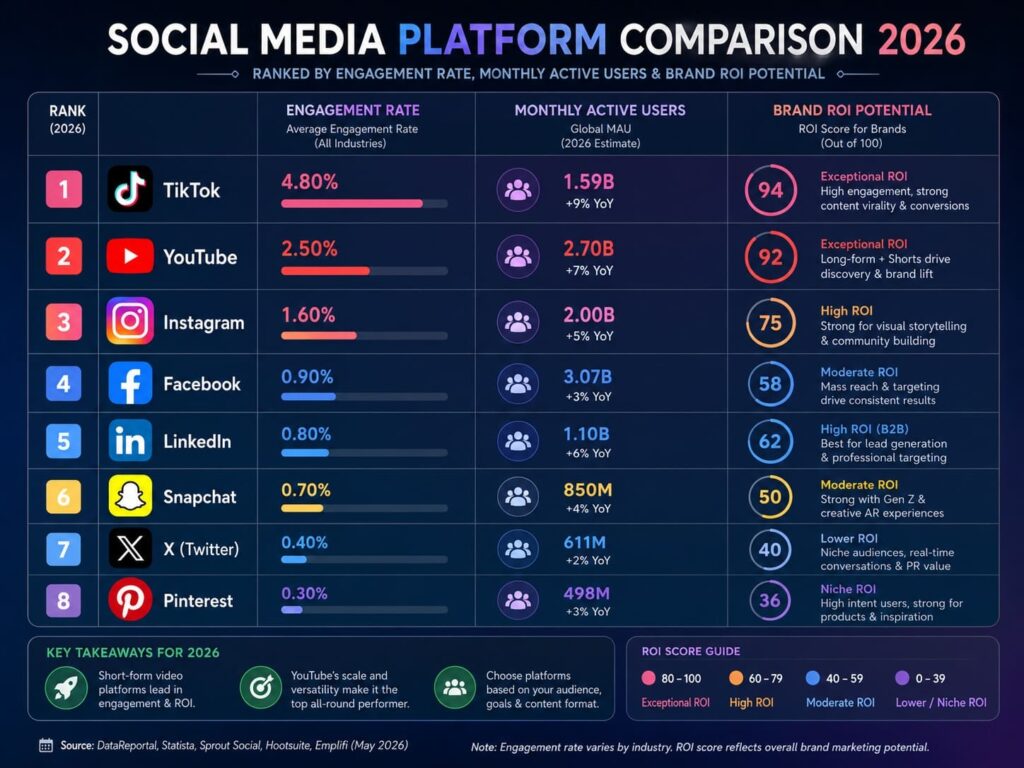
Best Social Media Platforms for Marketing in 2026 — Who Is Winning and Who Is Struggling
|
Platform |
Primary Strength |
Content Format |
Best For |
2026 Trend |
|
TikTok |
Discovery & Viral Reach |
Short-form video (15s–3min) |
B2C, retail, fashion, food, entertainment |
TikTok Shop acceleration; search behavior growing |
|
|
Visual Brand Building |
Reels, Stories, carousels |
Lifestyle, beauty, e-commerce, B2C |
Collab posts and creator partnerships driving reach |
|
YouTube |
Long-form Authority & Search |
Long-form + Shorts |
Education, B2B, product reviews, how-to |
Shorts monetization; AI-assisted scripting mainstream |
|
|
B2B Lead Generation |
Long-form text, video, newsletters |
B2B, SaaS, professional services, HR tech |
Thought leadership content outperforming company pages |
|
|
Purchase Intent Discovery |
Visual pins, idea boards |
E-commerce, home, fashion, food, DIY |
Visual search and AI-powered pin recommendations growing |
|
X (Twitter) |
Real-Time Conversation |
Text, threads, short video |
News, sports, tech, crypto niches |
Brand ad spend declining; community value in specific niches |
|
Threads |
Text-Based Community |
Text, image posts |
Early adopter brands, lifestyle |
Growing audience but low ad maturity |
|
Snapchat |
Gen Z Engagement |
Stories, Snaps, AR |
Retail, entertainment, Gen Z audiences |
AR lenses and Snap Map commerce expanding |
The most important insight from this landscape is that platform diversification without platform depth is a losing strategy. Brands attempting to maintain consistent quality across all eight platforms with a small team will produce mediocre content everywhere. The better approach is to focus on two or three best social media platforms for marketing where your specific audience is most active and most reachable, then expand from a position of strength.
Short-Form Video Marketing Trends: Still the Highest-ROI Format
Short-form video has been called a trend every year since TikTok went mainstream in 2020. In 2026, it is no longer a trend — it is the standard content format for consumer-facing brands. HubSpot’s 2025 State of Marketing report found short-form video delivered the highest ROI of any content format for the third year running, with 56% of marketers planning to increase short-form video investment in 2026.
What has changed is the sophistication required to perform. In 2022, a brand could win on TikTok simply by showing up and being consistent. In 2026, every brand has a Reels strategy. The audience has become more selective as short-form video marketing trends continue evolving as short-form video marketing trends continue evolving, the feed is becoming more competitive due to evolving social media marketing trends, and the content quality bar has risen accordingly.
What Makes Short-Form Video Work in 2026
- The first two seconds determine whether a viewer stays or scrolls — the hook has to be stronger than curiosity, it has to create a knowledge gap the viewer wants to close
- Native-feeling content — casual framing, direct-to-camera, unpolished — consistently outperforms high-production branded video in the social feed environment
- Captions are not optional: 85% of social video is watched without sound, and platforms algorithmically favor videos with on-screen text
- Platform culture matters: a TikTok that copies Instagram Reels format rarely performs as well as content made specifically for TikTok’s own conventions
- Retention signals drive algorithmic amplification — a 15-second video watched to completion signals more quality than a 60-second video abandoned at 10 seconds
Brands that are winning with short-form video in 2026 are typically doing one of two things: building an in-house content creator function with someone who understands the platforms natively, or working with micro-creators who already have an established presence in the relevant niche. Both approaches outperform the traditional model of having a marketing manager produce and post branded video content.
Social Commerce: From Discovery to Purchase Without Leaving the App
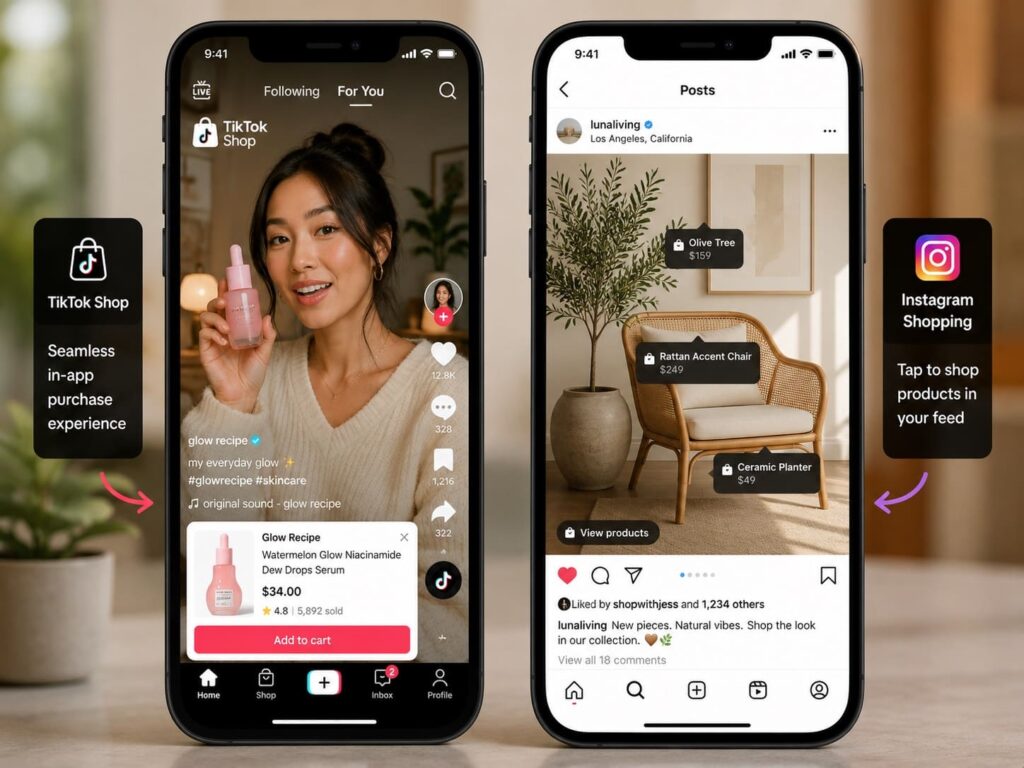
Social commerce trends in 2026 represents one of the most structurally significant developments in social media marketing. It collapses the traditional funnel — awareness to consideration to website visit to purchase — into a single platform experience. A user sees a product in a TikTok video, clicks to the product page, and buys without ever leaving the app. The friction reduction is substantial.
Social commerce trends in 2026 like TikTok Shop have demonstrated the scale of this opportunity. TikTok reported that TikTok Shop generated over $20 billion in gross merchandise value globally in 2023, with significant growth continuing through 2025. For certain product categories — beauty, fashion, food, home goods — TikTok Shop is now a primary sales channel rather than a supplementary one.
How to Build a Social Commerce Trends in 2026 Strategy
- Audit your current product catalog for social commerce readiness — visual products with clear benefits and moderate price points convert best in-feed
- Set up TikTok Shop and Instagram Shopping before investing heavily in social commerce content — the infrastructure needs to exist before the traffic matters
- Brief creators with affiliate commission structures — creator-driven content aligned with social commerce trends in 2026 dramatically outperforms brand-owned social commerce posts
- Track social commerce conversion rates separately from web conversion rates — the audience and the intent signals are different
- Optimize product listings for in-app search — TikTok and Instagram search are increasingly used for product discovery, not just general browsing
Influencer Marketing Trends and the Creator Economy in 2026
Influencer marketing trends in 2026 have matured significantly since its early days of one-off sponsored posts and opaque pricing. the most effective influencer strategies look less like advertising and more like ongoing content partnerships shaped by modern influencer marketing trends.
The data on micro-influencers has become compelling enough that most serious brands have shifted budget away from mega-influencers toward creators with 10,000 to 100,000 followers. A Sprout Social analysis found that micro-influencers average 3.86% engagement rates compared to 1.21% for influencers with over one million followers. For most product categories, this difference in engagement translates directly to higher conversion rates and better cost-per-acquisition.
Influencer Tier | Follower Range | Avg. Engagement Rate | Best Use Case | Cost Range |
Nano | 1K–10K | 5–8% | Hyperlocal, niche community trust-building | $50–$500/post |
Micro | 10K–100K | 3.5–5% | Targeted product promotion, authentic recommendation | $500–$5,000/post |
Mid-Tier | 100K–500K | 2–3.5% | Broader awareness with some conversion signal | $5,000–$20,000/post |
Macro | 500K–1M | 1.5–2.5% | Scale awareness campaigns, brand association | $20,000–$50,000/post |
Mega / Celebrity | 1M+ | 1–1.5% | Brand awareness at mass scale | $50,000+/post |
The shift toward long-term influencer marketing trends and creator partnerships — where a brand works with the same set of creators across multiple campaigns over months or a year — is the most significant structural change in influencer marketing trends in 2026. These partnerships allow creators to integrate a brand more authentically into their content over time, which builds audience familiarity that episodic sponsored content cannot replicate.
UGC (user-generated content) programs sit alongside influencer partnerships as an underutilized asset. Brands that incentivize customers to create and share content about their products — through review programs, community challenges, or loyalty rewards — build a content library that performs better than branded content and costs a fraction of influencer fees.
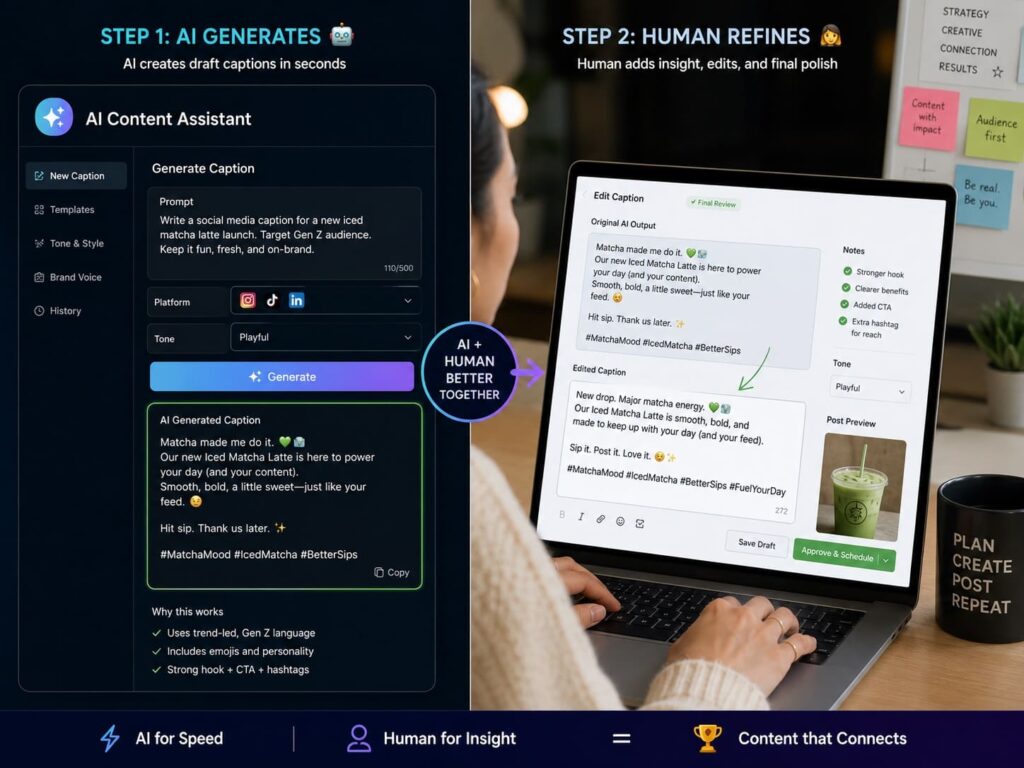
AI Social Media Marketing: What It Can and Cannot Do
AI Application | What It Does Well | Where It Falls Short |
Caption and copy generation | High-volume first drafts, A/B test variations, hashtag research | Brand voice consistency, platform-specific nuance, humor |
Content calendar planning | Scheduling frameworks, posting frequency recommendations, topic clustering | Creative originality, audience-specific relevance |
Comment and DM response drafting | Handling high volume, routing complex queries, template responses | Genuine empathy, brand relationship building, escalation judgment |
Creative brief generation | Brief structures, format guidance, trend research summaries | Breakthrough creative ideas, cultural awareness |
Performance analysis and reporting | Pattern identification, metric anomaly detection, cross-platform comparison | Strategic context, business-level interpretation |
Hashtag and keyword research | Volume data, trend identification, competitor analysis | Audience community context, emerging slang, niche terminology |
The brands producing the most effective AI-assisted social content in 2026 are using AI to handle production volume while keeping a human voice in the final editorial pass. The ratio that works for most teams is AI-generated drafts reviewed and refined by a human who understands both the brand and the specific platform culture.
The risk of fully automated social content — beyond the obvious quality issues — is that it trains audiences to associate your brand with generic, forgettable content. Once that association forms, reversing it takes significantly more effort than it would have cost to maintain quality from the start.
Community-Led Growth: Building Audiences You Own
Every major platform change in the past five years has shared one consequence: it reduced the reach and control that brands have over audiences they built on someone else’s platform. Algorithm changes cut organic reach. Policy updates restrict ad targeting. Platforms are acquired, rebranded, or decline in relevance.
The brands most resilient to these disruptions are the ones that treated social media as a top-of-funnel discovery channel rather than the entirety of their audience relationship. They used social to drive people into owned channels — email lists, SMS subscribers, branded communities on Discord or Slack — where the relationship continues independent of any platform’s algorithm.
Branded community building has accelerated in 2026. Brands across categories are launching member communities — either on standalone platforms or inside social apps themselves (Facebook Groups, LinkedIn Groups, Instagram Broadcast Channels) — and using exclusive content, early access, and direct access to brand representatives as the value proposition for joining.
Building an Audience You Actually Own
- Every piece of social content should have a path to an owned channel — a newsletter signup, a community invite, a free resource download that captures an email address
- Use social platforms for reach and discovery; use email and SMS for conversion and retention
- Branded Discord and Slack communities give high-intent customers a space to engage with each other and your brand simultaneously — this builds advocacy that social advertising cannot manufacture
- Instagram Broadcast Channels and LinkedIn Newsletters give brands a one-to-many communication channel inside a social platform with significantly better reach than standard feed posts
- SMS marketing, while not a social channel, works as a high-value fallback for your most engaged audience segment when other channels underperform
Social Media Algorithm Changes and What They Mean for Brands
Evolving social media marketing predictions show platform algorithms acting as the invisible hand shaping which content gets seen and which does not. In 2026, several algorithm shifts have material implications for how brands approach content strategy.
Platform | Key Algorithm Signal in 2026 | Strategic Implication |
TikTok | Watch time and replay rate weight heavily; interest graph over social graph | Optimize for retention, not follower count; non-followers can reach large audiences |
Reels given priority distribution; original content over reposted content | Invest in native Reels; avoid watermarked TikTok reposts | |
Dwell time and comment quality weighted over reaction volume | Long-form posts with genuine insight outperform short promotional posts | |
YouTube | Click-through rate and average view duration drive Shorts and long-form recommendation | Invest in thumbnails and first 30 seconds of long-form content |
Visual search match and save rate weighted heavily | Keyword-rich pin descriptions; high-quality vertical imagery for visual search | |
Reshares and Group engagement weighted; declining priority for brand pages | Invest in Group participation; brand page organic reach will continue to decline |
The common thread across all platform algorithm changes in 2026 is that they reward content that generates genuine, sustained engagement rather than passive impressions. A video watched completely, a post that generates thoughtful comments, a pin that gets saved — these signals all communicate to the algorithm that the content is worth amplifying. Content ignoring evolving social media marketing trends and optimized only for posting frequency or keyword stuffing performs worse than ever.
Challenges Brands Face on Social Media in 2026
Understanding the opportunities in social media marketing requires equal clarity about the challenges. These are the ones showing up most consistently across industries.
Declining Organic Reach
Organic reach has declined across nearly all best social media platforms for marketing. This is structural — platforms monetize through advertising, which means they have an incentive to limit organic reach so that brands pay for distribution. Brands that accept this reality and treat paid social as a required cost of audience reach are adapting. Those still expecting free reach to substitute for paid distribution are consistently disappointed.
Content Volume vs. Content Quality
AI social media marketing has made it easier to produce more social content — but the feed is accordingly more crowded. Posting more frequently without adapting to social media innovations or relevance produces diminishing returns. The brands gaining the most from social in 2026 are posting less frequently but investing more in each piece of content, particularly video.
Measurement and Attribution
Attribution remains one of the biggest challenges in the future of social media marketing in marketing analytics. Last-click attribution systematically undervalues social media’s role in the purchase decision, while multi-touch attribution requires data infrastructure most small and mid-size teams do not have. Dark social — content shared via DMs, WhatsApp, and private messaging — accounts for a significant share of social-driven traffic that never appears in standard analytics dashboards.
Platform Dependency Risk
Any business that depends on a single platform for a material portion of its revenue is exposed to policy changes, algorithm shifts, or platform decline. This risk materialized visibly when platforms changed their algorithm in ways that overnight reduced reach for brands that had built their entire social strategy around one channel.
Best Practices for Social Media Marketing in 2026
Lead with Video
Across every major platform, video content receives significantly higher organic reach and engagement than static images or text posts. This applies to both short-form (Reels, TikTok, Shorts) and long-form (YouTube, LinkedIn video). Brands ignoring short-form video marketing trends are operating with one hand tied behind their back.
Choose Platforms Based on Audience Evidence, Not Assumptions
The most common social media mistake is choosing platforms based on where the brand manager is personally active rather than where the target audience actually spends time. Use platform audience data, customer surveys, and social listening to identify where your specific audience is most reachable before committing budget.
Invest in Creator Relationships, Not One-Off Sponsorships
A single sponsored post rarely builds meaningful brand association with a creator’s audience. Long-term collaborations reflecting current influencer marketing trends to integrate your product into their content naturally are more expensive per post but deliver dramatically better brand recall and conversion rates.
Measure Engagement Quality, Not Just Volume
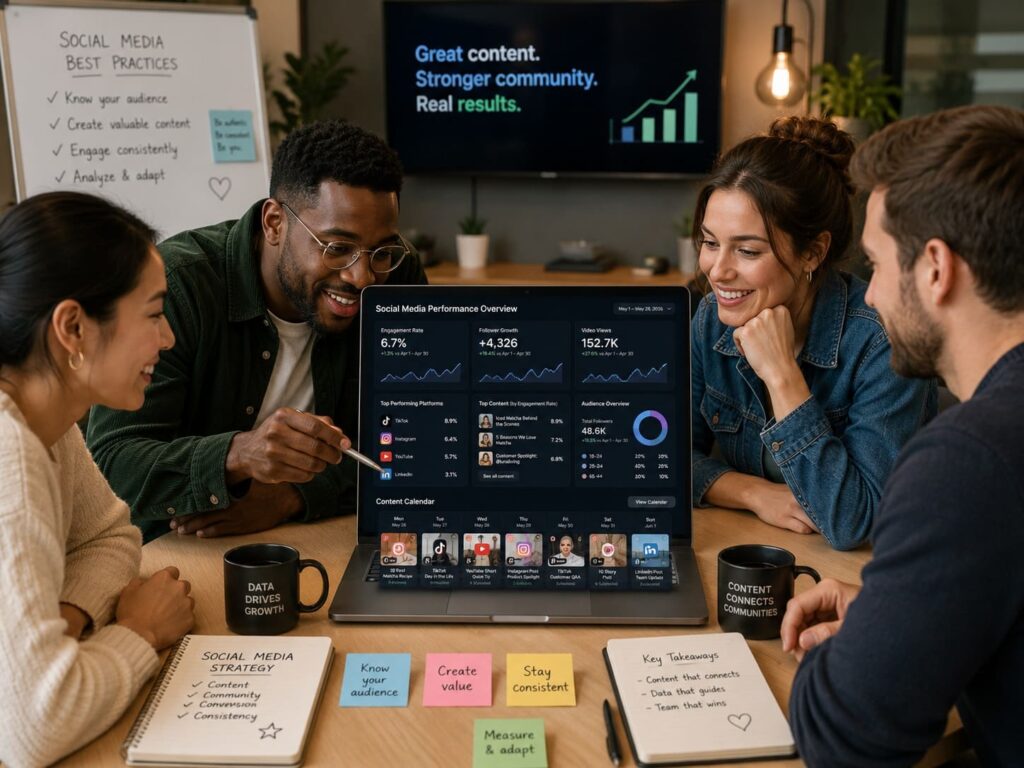
Comments, saves, and shares are stronger engagement signals than likes and impressions. A post with 500 comments asking genuine questions about your product is worth more than a post with 10,000 impressions and 200 likes. Track the metrics that indicate genuine audience interest, not just algorithmic amplification.
Build a Paid Amplification Budget Into Every Content Strategy
Current social media marketing trends show organic reach is no longer reliable enough to build a content strategy around in 2026. The brands performing best on social treat organic content as their creative and testing environment, and paid promotion as the distribution mechanism for their best-performing posts. This approach lets the content prove itself organically before budget is committed to amplifying it.
Common Mistakes to Avoid
Mistake | Why It Hurts | What to Do Instead |
Reposting TikTok content with watermarks to Instagram Reels | Instagram’s algorithm actively suppresses watermarked content in Reels distribution | Export original files without watermarks for cross-platform posting |
Treating all platforms as identical channels | Platform culture and audience expectations vary significantly; copied content underperforms | Adapt content format, tone, and structure to each platform natively |
Posting without a clear conversion goal | Social activity without direction produces engagement that does not move business metrics | Every post should have an objective: awareness, click, save, share, or purchase |
Chasing follower count over engagement quality | Large follower counts on platforms you cannot reach organically have limited business value | Invest in niche audience depth over broad follower acquisition |
Ignoring comments and DMs | Social media is a two-way channel; brands that broadcast without responding lose community trust | Build community management into the content workflow with defined response time SLAs |
Measuring success with vanity metrics only | Impressions and follower growth do not pay salaries; business outcomes require down-funnel measurement | Track social’s contribution to email captures, leads, and revenue, not just reach |
Future Outlook: What Comes Next
Several developments currently in early adoption will reach broader market impact in the next twelve to eighteen months.
AI-Generated Video at Scale
Text-to-video AI social media marketing tools (Sora, Runway, Kling) are approaching a quality level where brands can generate short-form video content without filming. The early applications are product demonstrations, explainer content, and ad creative variants. The limitation remains authenticity — audiences are developing an eye for AI video — but for certain use cases, particularly ad creative testing, AI video is already commercially viable.
Social Search as a Discovery Channel
TikTok and Instagram are increasingly shaping the future of social media marketing as visual search engines, particularly by Gen Z users who prefer video answers over text results. Optimizing social content for search — using keyword-rich captions, clear titles, and answering specific questions in video format — is becoming a meaningful SEO strategy in its own right, separate from Google optimization.
Decentralized Social Platforms
Bluesky and Mastodon have grown steadily among privacy-conscious and creator-focused users. While they have not displaced mainstream platforms, they represent an emerging audience segment that disproportionately includes journalists, academics, and early adopters who influence mainstream conversation. Brands with a thought leadership strategy should monitor these platforms even without investing heavily in them.
Extended Reality (XR) and Branded Experiences
Augmented reality filters on Instagram and Snapchat are already a functional brand marketing tool. As Apple Vision Pro and competing devices reach broader consumer adoption, immersive branded experiences will move from experimental to mainstream — particularly for fashion, retail, and entertainment brands.
Conclusion
The future of social media marketing in 2026 rewards brands that are platform-native, audience-obsessed, and willing to invest in genuine creative quality over volume. The playbook has changed: organic reach is earned rather than given, modern influencer marketing trends in 2026 outperform traditional brand-owned content in most categories, social commerce is a serious revenue channel, and audience ownership through email and community has become a strategic priority rather than an afterthought.
The brands pulling ahead are not doing more things — they are doing fewer things with more focus, better measurement, and a clearer line between social activity and business outcomes.
If you want help building a social media strategy that is grounded in platform data, audience research, and a realistic view of what actually drives results in 2026, Hawkeye Marketing can help. We work with brands across industries to build social strategies that are built to perform, not just to post.
About the Author
Hemanshi Parekh
Hemanshi Parekh is a digital marketing enthusiast passionate about helping businesses grow through SEO, content marketing, social media strategies, and performance-driven campaigns. With a strong interest in evolving digital trends, Hemanshi creates insightful, practical, and research-backed content that helps readers understand modern marketing strategies in a simple and actionable way.
FAQ
Platforms like Meta, HubSpot, Salesforce, Canva, and Adobe will offer advanced tools for campaign automation, analytics, and audience personalization. Businesses searching for best social media platforms for marketing should prioritize solutions supporting social commerce trends, AI-driven reporting, influencer management, and short-form video marketing trends to improve engagement and measurable results.
Companies including Meta, Google, TikTok, Adobe, and Salesforce are driving social media innovations through predictive analytics, creator tools, and automated advertising systems. Their platforms focus heavily on AI social media marketing, customer personalization, and social commerce trends. These innovations continue shaping social media marketing predictions for businesses planning digital campaigns.
Social media marketing trends in 2026 will include AI-generated content, personalized recommendations, social commerce expansion, and interactive short videos. Businesses must focus on authenticity, faster customer responses, and community-driven engagement. Short-form video marketing trends and influencer marketing trends will strongly affect purchasing decisions, audience loyalty, and brand visibility across platforms.
Leading technology companies are developing smarter tools for campaign automation, influencer partnerships, and customer targeting. Meta, TikTok, Google, and Adobe continue investing heavily in social media innovations powered by artificial intelligence. Their advancements support better analytics, content optimization, and personalized engagement, shaping future digital communication strategies for global businesses significantly.
Businesses in India can use regional language content, AI-driven analytics, and creator collaborations to strengthen online engagement by 2026. Understanding local audience behavior, mobile-first consumption, and social commerce trends will be important. Companies adopting advanced social media tools early can improve customer relationships, increase conversions, and stay competitive within modern markets.
AI-powered advertising platforms in 2026 will automatically generate captions, visuals, audience segments, and campaign testing variations. These AI social media marketing tools will analyze engagement data instantly, helping businesses improve targeting, reduce manual workload, and launch personalized advertisements faster. Automation will become essential within future of social media marketing strategies.
Emerging platforms focused on private communities, creator collaboration, live shopping, and immersive experiences will influence future of social media marketing strategies. Brands should monitor niche applications, gaming communities, and decentralized networks where engagement feels more authentic. Early adoption can improve visibility, audience trust, and long-term customer relationships across digital markets.
New social media platforms built around audio conversations, creator subscriptions, virtual experiences, and interest-based communities are gaining attention. These emerging channels encourage direct communication and stronger engagement. Businesses exploring best social media platforms for marketing should test smaller communities early to understand audience preferences before competition increases significantly across industries.