
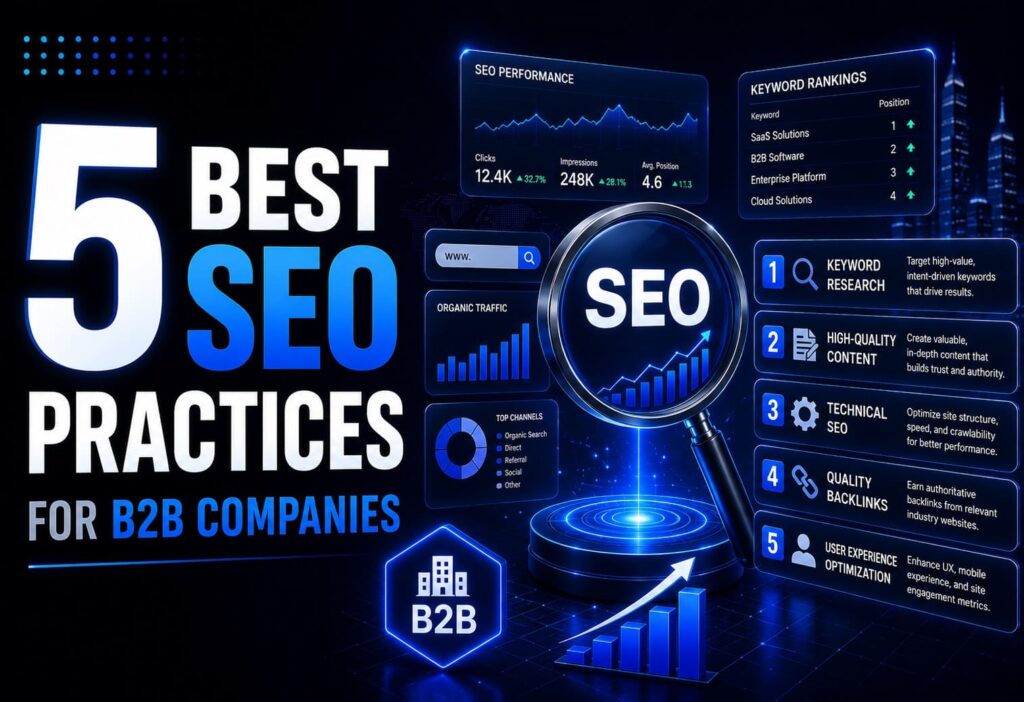
B2B SEO is harder than most marketing teams expect — and different in ways that standard SEO guidance rarely addresses clearly.
The keywords are lower volume. The buying cycle is long. The decision involves multiple stakeholders who search at different stages with entirely different queries. The content that ranks for B2B terms requires genuine domain expertise, not keyword repetition. And the competitive landscape in most B2B verticals has become significantly more sophisticated in the past two years, as companies that previously depended on paid search have invested inorganic as part of a stronger B2B SEO strategy 2026.The result is that B2B marketing teams applying a B2B SEO vs B2C SEO playbook are consistently disappointed with their results — not because SEO does not work for B2B, but because the B2B SEO best practices that work are different. This article covers the five B2B SEO best practices that consistently move the needle for B2B companies in 2026, with specific implementation guidance and the context needed to understand why each practice matters at this particular moment. Whether you manage SEO in-house or are evaluating partners like Hawkeye Digitals to support your B2B SEO strategy 2026 growth, these B2B SEO best practices form the B2B SEO strategy 2026 foundation that produces pipeline.

Table of Contents
ToggleB2B SEO vs B2C SEO: Key Differences
Understanding B2B SEO vs B2C SEO is essential because ranking strategies, buyer journeys, and conversion expectations differ significantly between the two models.
Dimension | B2B SEO | B2C SEO |
Keyword volume | Low to medium (50–2,000 searches/month) | Medium to very high (1,000–100,000+/month) |
Buying cycle | 3–12 months; multiple touchpoints | Days to weeks; typically 1–3 touchpoints |
Decision-makers | 6–10 stakeholders with different roles and queries | Usually 1 individual buyer |
Content depth required | Deep, technical, expert-authored | Accessible, emotional, visual |
Conversion goal | Demo request, whitepaper download, sales inquiry | Purchase, add to cart, signup |
Primary value of ranking | SEO for B2B lead generation pipeline contribution over 90-180 day cycle | Direct revenue from organic traffic |
Competitive landscape | Often dominated by specialist publications and incumbent brands | Varies widely by product category |
Link building difficulty | High — editorial links require genuine expertise signals | Moderate — broader range of linking opportunities |
The most important practical implication of this table is that B2B SEO vs B2C SEO success cannot be measured the same way. Organic traffic volume is a vanity metric in B2B — what matters is whether the right people are finding your content at the right moment in their evaluation process, and whether that content is converting them into identifiable pipeline opportunities.
Why B2B SEO Matters More in 2026 Than Ever Before
Three forces have increased the strategic importance of modern B2B SEO best practices in 2026.
First, the cost of B2B paid search has risen significantly. Google Ads CPCs in competitive B2B categories (SaaS, professional services, industrial, finance) have increased by 30–50% over the past three years, driven by more advertisers competing for the same keywords. Companies that built their pipeline primarily on paid search are under pressure to find more cost-efficient alternatives — and organic SEO, while slower to build, has dramatically lower cost-per-lead at scale.
Second, the B2B buyer’s research behavior has become increasingly self-directed. Gartner research found that B2B buyers spend only 17% of their purchase cycle time meeting with potential suppliers — the other 83% is independent research, much of it through search engines and AI tools. Brands that are not visible in organic search during that independent research phase are simply not part of the consideration set.
Third, Google’s Search Generative Experience has created both a threat and an opportunity for B2B marketers. The threat is that AI overviews answer informational queries at the top of the SERP without requiring a click. The opportunity is that B2B brands that produce authoritative, structured, directly answerable content are being cited inside those AI overviews — earning brand exposure to thousands of potential buyers without paying for a single click.This shift is now considered one of the best B2B SEO tactics 2026 for improving long-term organic visibility.
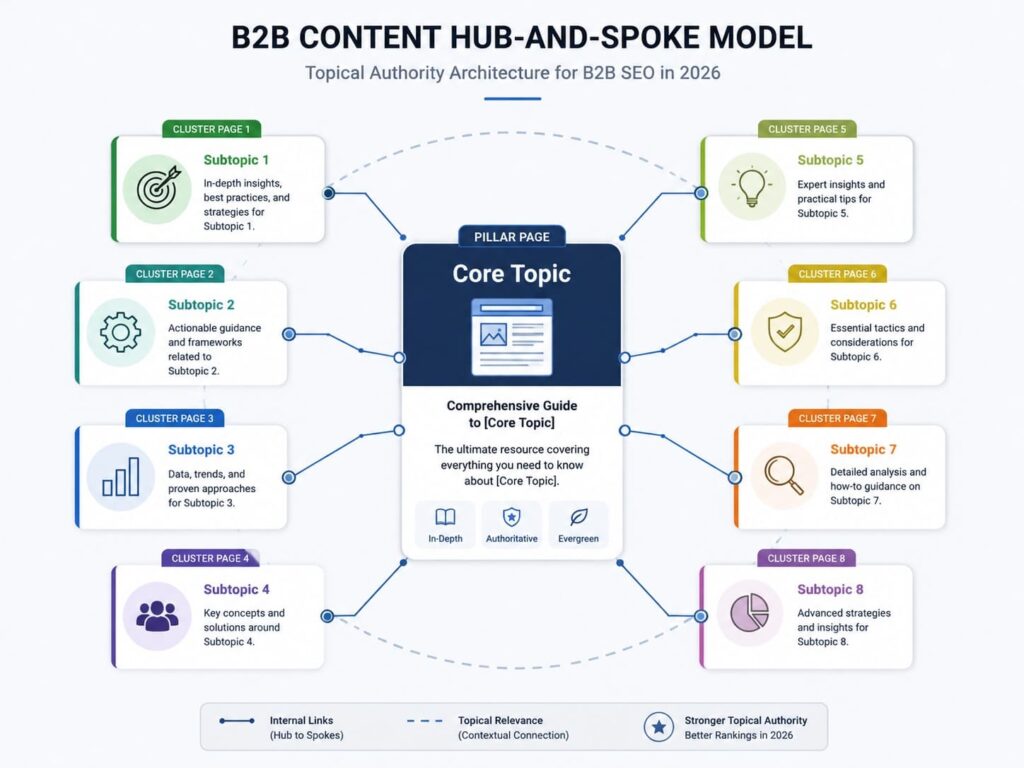
in B2B search in the past three years. Google’s Helpful Content System and its evolving understanding of semantic relationships between pages means that a B2B website with thirty deeply interconnected articles on a subject area will consistently outrank a website with three keyword-optimized pages targeting the same terms — even if those three pages are technically well-optimized.
For B2B companies, topical authority B2B SEO is both the strategy and the moat. Once you have built comprehensive coverage of a subject area that your buyers research, best B2B SEO tactics 2026 for ranking new keywords in that space becomes faster. Incoming links naturally cluster around the topical authority B2B SEO hub. Best B2B SEO tactics 2026 help AI search tools cite your content as a reference. Competitors face a significantly higher bar to displace you.
Building SEO for B2B Companies Through Topical Authority
- Define your topic universe: identify the two or three core subjects in your B2B keyword research strategy your brand should own, based on what your buyers research and where your genuine expertise lies
- Map the full question tree: for each core topic, research every subtopic, related question, and comparison query that buyers research at every stage of the purchase cycle
- Build pillar pages: create comprehensive, long-form guides (2,000–5,000+ words) on each core topic that serve as the topical authority B2B SEO hub for that subject
- Develop B2B content marketing SEO cluster content: write individual articles addressing each subtopic and question from the question tree, linking each back to the relevant pillar page
- Identify and close content gaps: use Ahrefs or Semrush to find queries your competitors rank for in your topic area that you do not — these are your highest-priority content investments
A B2B SEO case study involving a cybersecurity company building topical authority on ‘zero-trust network security’, for example, would need pillar content on the framework itself, cluster content on implementation guides, vendor comparisons, case studies by industry vertical, regulatory compliance implications, and answers to specific technical questions that security engineers and CISOs search during evaluation. Each piece of content supports the others, and the collective topical coverage signals to Google that this company is a genuine authority on the subject.
One of the most overlooked B2B SEO best practices is avoiding content production without explicit intent mapping.
Teams write articles, publish case studies, and build resource libraries without asking a fundamental question: who is searching for this, at what point in their decision process, and what do they need to know to move forward?
B2B purchase decisions involve multiple people — technical evaluators, financial approvers, end users, and executive sponsors — each of whom searches differently. The CISO searching for ‘zero trust security frameworks’ has entirely different information needs from the CFO searching for ‘cybersecurity investment ROI’ or the IT manager searching for ‘zero trust implementation checklist’. Content that serves one persona and intent stage well will not serve the others.
Intent Stage | Buyer Mindset | Content Type That Works | SEO Goal |
Awareness | Recognizing a problem or opportunity; not yet evaluating solutions | B2B content marketing SEO educational guides, industry reports, thought leadership, trend analysis | Rank for problem-aware informational queries; build brand familiarity |
Consideration | Actively researching solutions and approaches; comparing categories | Comparison guides, framework explainers, webinars, detailed how-to content | Rank for solution-category keywords; capture mid-funnel intent |
Decision | Evaluating specific vendors; building business case for a purchase | Case studies, ROI calculators, product demos, testimonials, technical documentation | Rank for vendor comparison and review queries; convert to pipeline |
Retention / Expansion | Current customer exploring additional use cases or products | Advanced guides, feature update content, community resources, upsell content | Support account expansion; earn brand advocates who drive referrals |
how to do SEO for B2B companies with intent mapping in practice means assigning every page on your website — existing and planned — to a specific intent stage and persona before any B2B keyword research strategy targeting or content briefing happens. This prevents two failure modes that are endemic in B2B content programs: producing too much awareness content because it is easier to write, and leaving decision-stage queries unaddressed because case studies and technical documentation are more resource-intensive to produce.
How to Do SEO for B2B Companies With Intent Mapping
- Pull your existing keyword rankings from Google Search Console and categorize each by intent stage
- Identify which stages are over-represented and which are gaps — most B2B sites have too much awareness content and too little decision-stage content
- For each content gap, identify the specific query in your B2B keyword research strategy
, the persona it serves, and the conversion action the content should drive - Brief new content with explicit intent stage, target persona, primary query, and conversion goal — not just a keyword and a word count
- Track not just ranking position but down-funnel impact: which pages drive demo requests, which drive whitepaper downloads, which drive direct sales inquiries
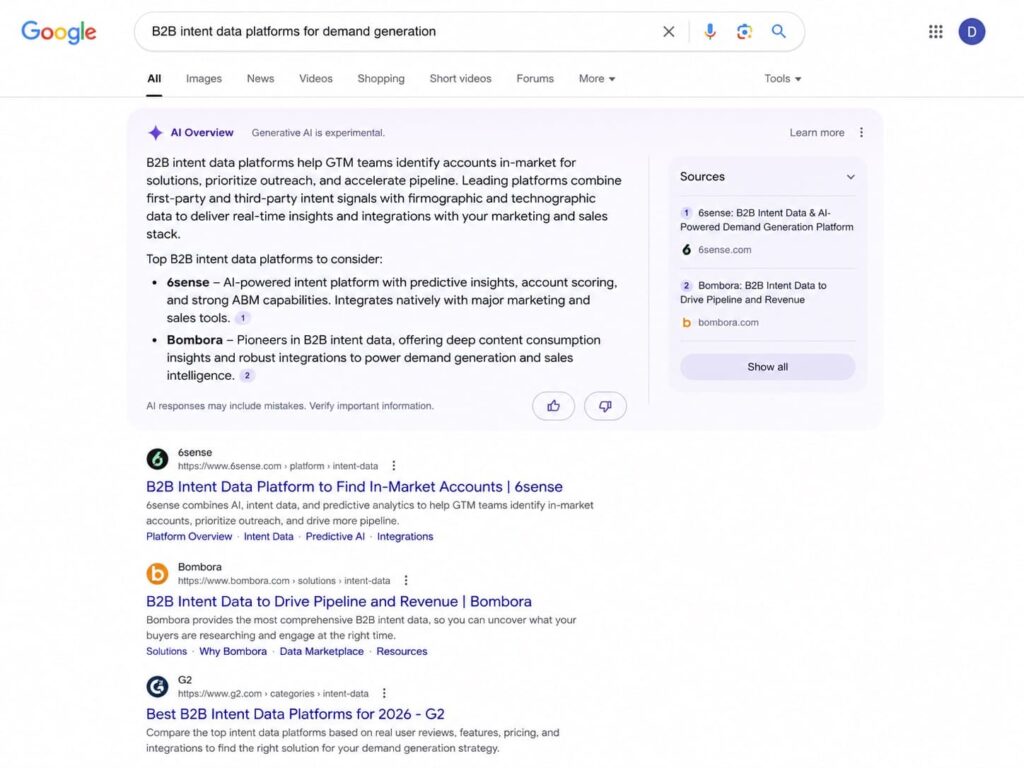
Google’s Search Generative Experience is already reshaping how B2B buyers encounter content in search results. For informational queries — ‘how does zero-trust security work’, ‘what is account-based marketing’, ‘how to evaluate SaaS vendors’ — AI overviews appear at the top of the SERP, synthesizing answers from multiple authoritative sources. Brands whose content is cited in these overviews receive brand exposure to thousands of potential buyers without a click being required.
The mechanics of being cited in AI overviews are not fully transparent, but the evidence strongly suggests that content with clear E-E-A-T signals, structured formatting, explicit question-answer pairs, and schema markup is significantly more likely to be cited than content optimized purely for traditional ranking signals.
SGE Optimization Checklist for B2B Content
- Use explicit H2 or H3 questions (starting with What, How, Why, When, Which) as section headers — these are directly extractable by AI systems
- Open each question-based section with a direct 40–60 word answer that can stand alone without surrounding context
- Implement FAQPage schema on content pages that contain question-and-answer structures
- Add Article schema with author credentials and publication date to all editorial content — author expertise signals matter to AI systems evaluating E-E-A-T
- Cite specific data, studies, and named sources within the content — AI systems prefer content that demonstrates evidential authority
- Structure comparison content with explicit tables rather than prose comparisons — tabular data is easier for AI systems to extract and reference
- Keep introductory paragraphs concise and factual — AI overview citations tend to pull from the clearest, most direct content rather than nuanced editorial writing
For B2B brands, the SGE opportunity is particularly significant because their buyers are using AI-powered search tools (Google SGE, Perplexity, ChatGPT search) at the research stage of the purchase cycle. Being consistently cited as a reference source in those AI-generated answers builds brand authority that functions independently of click-through behavior — buyers encounter your brand name in authoritative context before they ever visit your website.
Technical SEO is one of the most neglected areas within modern B2B SEO best practices — not because teams do not know it matters, but because technical issues are harder to identify without specialist tooling and require developer involvement to fix. The result is that many B2B websites carry undiagnosed technical problems that significantly limit their organic potential regardless of how good their content is.
B2B websites have a specific set of technical SEO for B2B websites challenges that differ from consumer sites. Complex navigation architectures with many layers of subcategories create technical SEO for B2B websites crawl depth problems. Gated content behind registration walls removes pages from Google’s index entirely. Product configurators and dynamic content built on JavaScript often fail to be crawled correctly. Session-based URL parameters create duplicate content at scale. These issues rarely appear in surface-level reviews — they require a systematic technical SEO for B2B websites audit.
Technical Issue | Why It Is Common on B2B Sites | Impact on SEO | Fix |
Slow Core Web Vitals | Complex CMS platforms, heavy JavaScript, large assets (whitepapers, case study PDFs) | Ranking penalty; poor user experience for mobile decision-makers | Audit with PageSpeed Insights; prioritize LCP and CLS improvements; compress assets |
Crawlability blocks on gated content | Lead gen strategy gates whitepapers and case studies behind registration forms | High-value pages not indexed; no ranking potential for gated URLs | Create ungated preview pages with schema; allow indexing of summary pages |
Session parameter URL duplication | CRM tracking parameters (?utm=, ?session=) create duplicate page versions | Crawl budget waste; potential duplicate content penalty | Implement canonical tags; use URL parameter handling in GSC |
Deep site architecture | Enterprise B2B sites with hundreds of product subcategories bury important pages | Crawlers deprioritize pages more than 3–4 clicks from homepage | Flatten architecture; add key pages to XML sitemap; improve internal linking |
Missing or weak schema markup | B2B sites rarely implement Organization, Article, or FAQPage schema | Reduced rich result eligibility; lower AI overview citation potential | Implement Schema.org markup for Organization, FAQPage, Article, and Product |
JavaScript-rendered content | Modern B2B sites built on React/Vue often render content client-side | Googlebot may not index JavaScript-rendered content reliably | Test with URL Inspection tool in GSC; implement server-side rendering for critical content |
How to Do SEO for B2B Companies With Technical SEO Audits
- Crawl your entire site with Screaming Frog — look for broken links, redirect chains, missing metadata, and pages blocked from indexing
- Run a Core Web Vitals report in Google Search Console — identify pages failing LCP, FID, and CLS thresholds
- Check URL Inspection in Google Search Console for your most important pages — confirm they are indexed and that the rendered HTML matches what you expect
- Run your homepage and key product pages through Google’s Rich Results Test — identify missing schema opportunities
- Review your robots.txt and sitemap.xml — confirm you are not accidentally blocking important pages from crawlers
- Audit your internal linking — every important page should be reachable within three clicks from the homepage and should receive internal links from related content

Backlink authority remains one of the most durable ranking signals in competitive B2B SEO. A new piece of content on a domain with high authority (DR 70+) will rank faster and at higher positions than identical content on a domain with low authority (DR 30). The corollary is that B2B companies ignoring link building are fighting for rankings with both hands tied behind their back, regardless of how good their B2B content marketing SEO is.
The challenge is that traditional link building tactics — directory submissions, blog comment links, low-quality guest posts — provide minimal value and carry penalty risk. What works in B2B is what Google’s guidelines have always pointed toward but what most teams resist because it takes genuine effort: earning links through the quality and originality of your content.
How to Do SEO for B2B Companies With Link Earning
- Original research and proprietary data: B2B companies that publish B2B SEO case study research, B2B SEO case study benchmarking reports, or unique datasets earn links naturally because other publications cite them as a source — this is the most scalable long-term link earning strategy
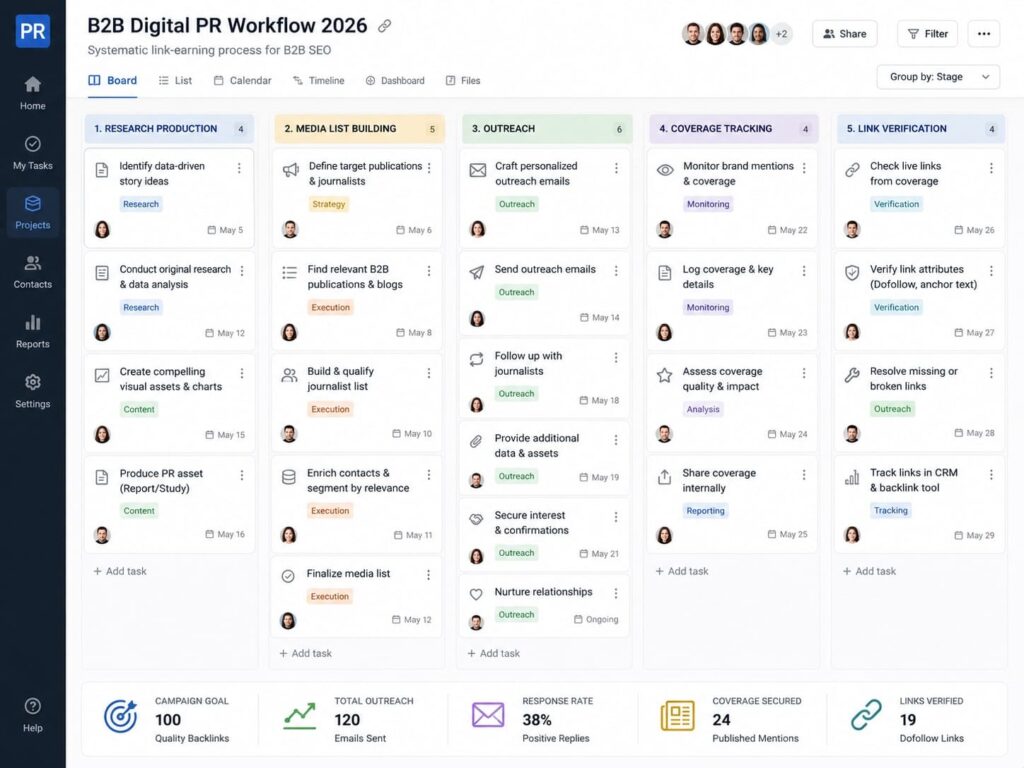
- Digital PR: pitching journalists, industry publication editors, and podcast hosts with expert commentary, unique data, or contrarian perspectives on industry trends earns editorial mentions from high-authority domains
- Contributed content in industry publications: strategic guest contributions to respected industry publications (not content farms) build domain authority and establish author credentials simultaneously
- Resource link building: creating genuinely useful tools (calculators, templates, benchmarking frameworks) that other sites naturally link to as references for their own audiences
- Expert roundups and industry panels: participating as a named expert in third-party roundup articles earns links while building personal brand authority for key executives
- Broken link building: identifying broken links on authoritative industry sites and offering your relevant content as a replacement — time-intensive but highly targeted
The link building approach that consistently delivers the highest ROI for B2B companies is original research. A well-executed annual industry survey — with 200+ respondents, clean data visualization, and an ungated executive summary — will earn dozens of inbound links from publications that cite the data. The upfront investment is meaningful, but the links compound over years as the research continues to be referenced.
A realistic benchmark for B2B SEO: expect six to twelve months before a new link-building program produces measurable domain authority improvement, and eighteen to twenty-four months before that authority improvement translates into materially better rankings in competitive keyword categories. Link building is a compounding asset, not a quick fix.
How These Five Practices Work Together
The five B2B SEO best practices in this guide are not independent tactics — they form an integrated system. Topical authority provides the content architecture. Intent mapping ensures each piece of content reaches the right buyer at the right moment. SGE optimization ensures that content is visible not just in traditional search results but in AI-generated overviews. Technical SEO ensures that all of this content is actually crawlable, indexable, and performant. And domain authority through link earning ensures that the content ranks competitively against well-funded incumbents.
Removing any one of these elements from the system creates a bottleneck. The best content strategy in the world will not produce results if the site has technical crawlability issues. Strong domain authority will not overcome content that fails to match buyer intent. Great technical SEO on a site with low domain authority will rank slowly in competitive verticals.
The order of implementation matters.One of the best B2B SEO tactics 2026 is starting with technical SEO — it is pointless to invest in content on a broken foundation. Then build your content architecture and intent mapping framework before how to do SEO for B2B companies at scale. Begin link earning in parallel with content production. And apply best B2B SEO tactics 2026 for SGE as you produce each piece of content, not as a retrospective exercise.

Common B2B SEO Mistakes to Avoid
Mistake | Why It Hurts | What to Do Instead |
Targeting only high-volume keywords | High-volume B2B keywords are dominated by established players; ranking takes years and may never happen | Target low-volume, high-intent decision-stage keywords through a B2B keyword strategy, where competition is lower and conversion is higher |
Publishing content without E-E-A-T signals | Anonymous, uncredentialed content ranks poorly under Google’s quality guidelines | Add author bios with credentials; cite sources; include original data and expert perspectives |
Treating SEO and demand gen as separate programs | Siloed teams produce content that ranks but does not convert, or content that converts but does not rank | Align content briefs with both keyword intent and lead nurturing goals from the first draft |
Ignoring internal linking | Content that is not internally linked is poorly surfaced to both crawlers and users | Every new piece of content should link to and receive links from at least three existing related pages |
Measuring B2B SEO success with traffic alone | Traffic without SEO for B2B lead generation contribution data leads to investment in wrong content types | Connect GSC and GA4 to CRM data; track which organic pages contribute to SEO for B2B lead generation pipeline |
Starting link building before content is ready | Earning links to thin or un-optimized content wastes authority and misses conversion opportunities | Build foundational pillar content first; then earn links to pages that can actually convert visitors |
Future Outlook: Where B2B SEO Is Heading
Several developments currently in early adoption will become mainstream B2B SEO practice in the next twelve to eighteen months.
AI-Augmented Content Production at Scale
B2B marketing teams are using AI to produce content briefs, first drafts, and research summaries at a pace that was not feasible twelve months ago. The teams using this most effectively are those that maintain clear human editorial standards in the final output — using AI to eliminate the blank page, not to replace strategic thinking and genuine expertise. As AI content production becomes universal, the differentiator shifts from content volume to content authenticity and original insight.
Personalized Organic Experiences
B2B websites are beginning to use visitor intelligence (company identification tools like Clearbit or Bombora) to personalize organic landing page experiences based on the visitor’s company size, industry, or intent data. A visitor from a financial services firm sees industry-specific case studies and use cases; a visitor from a manufacturing company sees a different version. This is nascent but represents the natural evolution of intent-based content strategy.
Search Across Multiple AI Platforms
In 2026, B2B buyers are using not just Google but Perplexity, ChatGPT, Gemini, and Claude as research tools. Being cited across these platforms requires the same foundational practices — authoritative content, clear structure, strong sourcing — but the specific optimization signals may differ by platform. B2B brands that monitor their visibility across AI search tools, not just Google, will maintain a more complete picture of their organic reach.
Video SEO for B2B
YouTube is the second-largest search engine globally, and B2B buyers increasingly use it to evaluate complex products and solutions through demos, comparisons, and thought leadership content. B2B companies with a YouTube SEO strategy — optimized titles, descriptions, chapters, and transcripts — are building a search presence that is not directly replicable by text content competitors.
Conclusion
A successful B2B SEO strategy 2026 is not about gaming an algorithm — it is about genuinely serving the information needs of your target buyers at every stage of a complex, multi-stakeholder purchase decision. The five B2B SEO best practices in this guide — topical authority, intent mapping, SGE optimization, technical SEO, and domain authority through link earning — form a complete, integrated system for building B2B SEO strategy 2026 visibility that compounds over time and produces qualified pipeline.
The brands that execute all five consistently will build a durable competitive advantage in organic search that no paid advertising budget can easily displace. Those that treat SEO as a checkbox activity will continue to underperform relative to their domain expertise and marketing investment.
If your team has the content expertise but lacks the SEO infrastructure, or has technical capability but is not producing the right content for buyer intent, Hawkeye Marketing works with B2B companies at exactly that gap — building the strategy, infrastructure, and execution capacity that translates organic investment into pipeline through future digital marketing strategies.
About The Author
Hemanshi Parekh
Hemanshi Parekh is a digital marketing enthusiast passionate about helping businesses grow through SEO, content marketing, social media strategies, and performance-driven campaigns. With a strong interest in evolving digital trends, Hemanshi creates insightful, practical, and research-backed content that helps readers understand modern marketing strategies in a simple and actionable way.
FAQ
Effective SEO for generating B2B leads involves optimizing service pages, offering useful downloadable resources, and using targeted keywords. Companies should develop informative content that addresses the specific challenges customers face, while also enhancing the technical SEO of their B2B websites. By integrating search engine optimization with straightforward conversion paths, businesses can draw in qualified leads and support long-term growth through consistent organic traffic.
B2B companies can improve search rankings by publishing valuable industry content, optimizing technical performance, and targeting intent-driven keywords. Building topical authority B2B SEO strategies through case studies, service pages, and educational resources increases credibility. Regular audits, strong internal linking, and mobile optimization also help businesses achieve better organic visibility and consistent growth.
SEO services for B2B businesses in India should focus on industry-specific keyword targeting, technical optimization, and lead-focused content strategies. Agencies must understand B2B buying cycles, decision-maker behavior, and local market competition. Strong B2B SEO strategy 2026 plans combine SEO for B2B lead generation with content authority, analytics, and conversion optimization effectively.
Tools like Ahrefs, SEMrush, Google Keyword Planner, and Clearscope help businesses discover niche industry search opportunities. A strong B2B keyword research strategy focuses on buyer intent, long-tail phrases, and competitor analysis instead of high-volume keywords alone. These platforms also support topical authority B2B SEO planning and long-term organic visibility growth efforts.
Successful B2B marketing campaigns often use tools like Google Search Console, Screaming Frog, SEMrush, Ahrefs, and HubSpot for tracking and optimization. These platforms improve technical SEO for B2B websites, monitor keyword performance, and identify content gaps. Combining analytics with automation helps businesses execute scalable and measurable SEO campaigns more efficiently overall.
Top B2B SEO best practices include improving website speed, publishing expert-level content, and optimizing pages for search intent. Businesses should strengthen B2B content marketing SEO through case studies, whitepapers, and comparison guides. Building backlinks from industry websites and maintaining consistent keyword optimization improves online visibility and long-term search performance across competitive markets.