

Most businesses begin hiring a digital marketing agency by asking for a portfolio & that’s not enough. A portfolio shows you what an agency has done; the right questions reveal whether they can do it for you.
At Hawkeye Digital, we have seen what separates agencies that genuinely grow businesses from those that look impressive in a pitch deck. This article gives you a practical, no-nonsense framework for hiring a digital marketing agency before signing a single contract.
Table of Contents
ToggleWhy Hiring a Digital Marketing Agency Starts With More Than the Portfolio
A portfolio is a curated highlight reel. Every agency shows you their best work — the campaigns that landed, the clients who stayed, and the results that photographed well in a slide deck. What it does not show you is how they handle underperforming campaigns, difficult client feedback, or market disruptions mid-engagement.
The questions you ask in a discovery call carry far more signal. Agencies that ask you smart questions back, help you understand what to look for in a digital marketing agency beyond surface-level promises, and are honest about timelines are worth your attention. Agencies that avoid discovery conversations often become major digital marketing agency red flags are usually optimized to close deals, not to deliver results.

Why Hiring a Digital Marketing Agency Matters More in 2026
The digital marketing landscape in 2026 is more competitive, algorithm-sensitive, and AI-influenced than at any previous point. Google’s helpful content updates, the expansion of AI-generated search overviews, and rapid shifts toward short-form and conversational content mean that poor agency choices are not just expensive — they can cause lasting brand damage.
Digital ad spending in India continues to grow at a double-digit annual rate, with businesses of all sizes allocating larger shares of revenue to digital channels. In that environment, poor agency selection often happens when businesses ignore proper digital marketing agency selection criteria who chose the right one. The agency you hire in 2026 must understand modern SEO, AI search visibility, and digital marketing agency reporting and transparency, intent-based targeting, content E-E-A-T, and attribution modeling across fragmented digital touchpoints — and most portfolio slides will not confirm whether they do.
Questions to Ask Before Hiring a Digital Marketing Agency
The single most important question to ask any digital marketing agency is: “Walk me through your process from the initial brief to the first campaign launch.” A great agency will describe a structured intake, discovery, research, and strategy phase — before touching a single ad or publishing a single post. A weak one will jump straight to execution. This question alone surfaces strategic thinking, the operational depth needed when hiring a digital marketing agency, and how seriously the agency takes how to choose the right digital marketing agency for my business before spending your budget.
Question to Ask | What You’re Listening For | Red Flag Answer |
Walk me through your process from brief to launch | Structured discovery; strategy before tactics | “We’ll build a deck and start posting” |
How do you measure success for businesses like mine? | Business KPIs — CPL, ROAS, revenue attribution | “We track impressions, reach, and engagement” |
What does your reporting look like, and how often? | Regular, interpretable reports with insights | Monthly PDF email you can’t parse alone |
Who specifically will manage my account? | Named senior strategist with relevant experience | “A dedicated team handles all client accounts” |
What happens if a campaign underperforms? | A structured recovery process instead of common digital marketing agency red flags | Silence, defensiveness, or blame-shifting |
What do you need from us to succeed? | Honesty about expectations that clarify what questions should I ask a marketing agency before signing | “Just approve our work and we’ll handle everything” |
The account management question is consistently overlooked. Many agencies win the pitch with senior talent, then assign the account to a junior executive once contracts are signed. Ask directly who your day-to-day contact will be, what their experience level is, and whether they will attend every review call.[7]
Asking “What do you need from us to succeed?” separates vendors from partners. A vendor manages tasks. A partner tells you that without timely creative feedback, clear brand guidelines, and internal access to customer data, their strategy will be limited — and that honesty is a green flag worth noting.
Digital Marketing Agency Red Flags Before You Sign
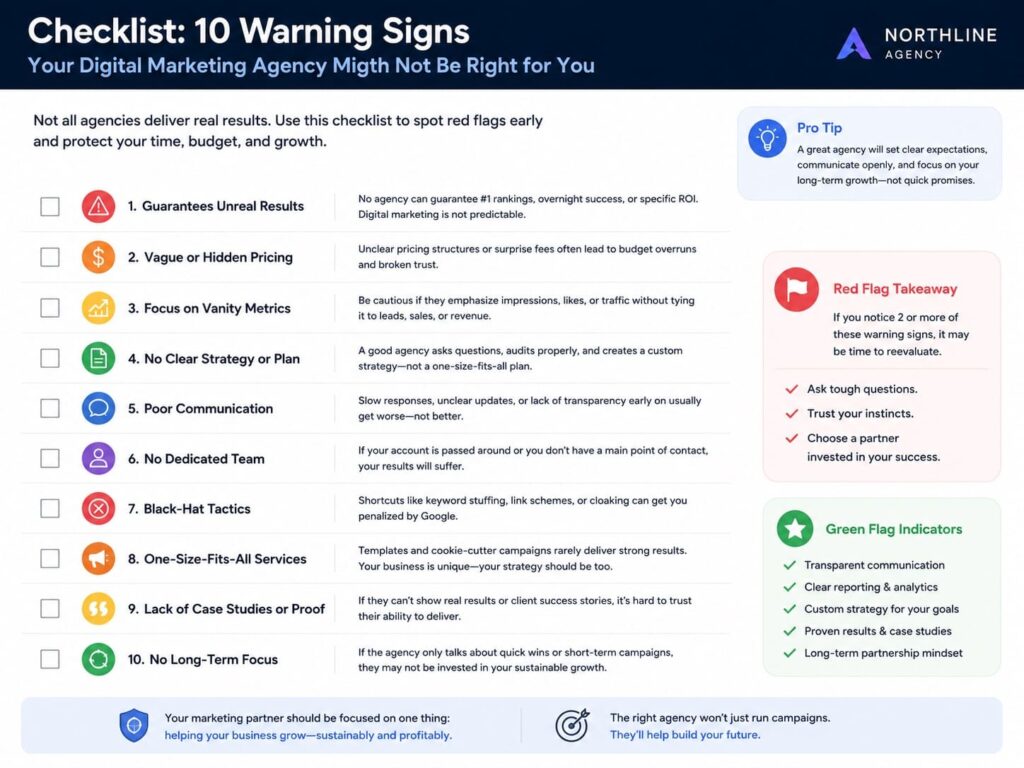
The most dangerous agency is not the one with no portfolio — it is the one that sounds compelling but behaves badly once you are locked into a contract. Identifying these digital marketing agency red flags early can save months of wasted budget and significant budget.
Promises That Should Raise Eyebrows
An agency that guarantees “#1 on Google” or “10x ROAS in 30 days” is either uninformed or dishonest. SEO typically takes 3–6 months for meaningful movement, and paid ad ROAS depends on product-market fit, creative quality, and landing page performance — variables no agency fully controls on day one.
- Vague strategy language: Phrases like “data-driven results” without specifics are positioning, not strategy.
- Pressure to sign quickly: Legitimate agencies welcome due diligence; aggressive urgency tactics are among the biggest digital marketing agency red flags.
- No metrics in case studies: Logo walls and client names are not proof — ask for measurable outcomes when learning how to evaluate a digital marketing agency or revenue attribution data.
- They never push back: An agency that agrees with everything you say is not a strategic partner; the best ones challenge briefs and suggest strategic thinking that reflects strong digital marketing agency selection criteria.
- One-size-fits-all proposals: A pitch that could have been written for any company of your size was probably written for any company of your size.
Digital Marketing Agency Reporting and Transparency
Transparency is one of those words every agency uses and very few actually practice. In practical terms, it means you can always see whether the agency follows proper digital marketing agency reporting and transparency practices, what results it produced, and what is being done about what is not working.
Budget Allocation: Can the agency provide a clear breakdown of how your monthly retainer or ad budget splits between ad spend, management fees, content creation, and tools? If they cannot or will not itemize this, clarify this while deciding how to choose the right digital marketing agency for my business.
Data Access: You should have direct access to your Google Analytics, Meta Ads Manager, and all platform accounts. This is one of the most important factors in digital marketing agency selection criteria. When an agency controls the accounts, they control the data — and you lose access the moment the relationship ends.
Honest Performance Reviews: Businesses should evaluate whether agencies follow real digital marketing agency reporting and transparency in monthly reports. They explain what did not work, why, and what they are changing. If every report is uniformly positive, the agency is either filtering the truth or not looking hard enough at the data.
The Reporting Question Most Businesses Never Ask When Hiring a Digital Marketing Agency
Most businesses forget to ask what questions should I ask a marketing agency before signing regarding reporting. The smarter question is: “What metrics will you report on, and how those metrics are relevant to my businesses?”
Vanity metrics are data points that look impressive but have no direct connection to business revenue. Business metrics are the numbers that reflect whether your marketing investment is actually growing the company. Agencies that optimize for engagement and reach can show you months of “positive performance” while your actual pipeline remains dry.
Vanity Metric | Business Metric Equivalent |
Page Impressions | Qualified visitors from target audience segments |
Follower Growth | Audience engagement tied to product interest |
Post Likes | Click-throughs to product or service pages |
Total Ad Reach | Cost per qualified lead (CPL) |
Video Views | View-to-inquiry conversion rate |
Keyword Rankings | Organic traffic converting to leads or revenue |
Ask your prospective agency to share a sample report from a current client with sensitive information removed. If the report is built around impressions, reach, and engagement — and lacks conversions, CPL, ROAS, or revenue attribution — that tells you exactly what the reporting relationship will look like for the next 12 months.
Cultural Fit: The Underrated Deal-Maker
Strategy can be borrowed. Execution can be structured. But culture — how a team communicates, responds to problems, and handles disagreement — becomes a major factor in how to choose the right digital marketing agency for my business or a constant negotiation.
Ask about communication cadence: Do they prefer email, Slack, WhatsApp, or calls? How quickly do they respond to urgent situations? What is their escalation path when something goes wrong mid-campaign? What does their client relationship look and feel like at the 12-month mark compared to the first 30 days?
Some agencies are fast-moving and high-output — ideal for brands that want aggressive campaigns and rapid iteration. Others are methodical and process-heavy — better suited for regulated industries or long-cycle B2B businesses. Neither style is wrong; the key is that their working style aligns with your digital marketing agency selection criteria.
Digital Marketing Agency Selection Criteria: Pricing, Contracts, and the Exit Clause Nobody Mentions
Agency pricing comes in several structures — monthly retainers, project-based fees, performance-linked pricing, and hybrid models. understanding these tradeoffs is essential when learning how to evaluate a digital marketing agency, and none is universally superior.
- Monthly retainer: Predictable and good for ongoing campaigns — but define the scope of work clearly; scope creep is the most common retainer problem
- Project-based: Appropriate for one-time work like website builds or launch campaigns — be explicit about revision limits and asset ownership at delivery
- Performance-based: Appealing in theory, but can incentivize short-term metric optimization over sustainable business growth
- Hybrid: Combines a base retainer with a performance bonus — often the most balanced structure for long-term partnerships
The Exit Clause Conversation
Always ask: “What are your contract cancellation policy, and In case of cancellation who will own the accounts, content, and assets?” Some agencies retain ownership of ad accounts, creative assets, or websites built under their management — and this is entirely avoidable if you negotiate it upfront.
A 30-day exit clause with full account and asset transfer to the client is a reasonable standard. Anything longer, or contracts with ownership restrictions, should be negotiated before signing — never after a dispute has already begun.
How to Choose the Right Digital Marketing Agency for My Business
A consistently underappreciated reality: poor agency outcomes are sometimes the client’s fault. Before you hire an agency, honestly audit your readiness to be a good partner.
- Do you have clear, measurable business goals? An agency cannot define KPIs for you — arrive with a specific objective, whether that is 100 qualified leads per month, a 30% increase in organic traffic, or a defined revenue target.
- Do you have brand assets ready? Logo files, brand guidelines, tone-of-voice documents, and product photography should not be the agency’s first project on your account.
- Who is your internal point of contact? Someone on your team needs to own the agency relationship, provide timely approvals, and communicate feedback within agreed turnaround windows.
- Are your timeline expectations realistic? SEO takes months; paid ads require 4–8 weeks of optimization — if you need results in 30 days, either adjust expectations or focus on channels that can move faster.
- Is your website ready to receive traffic? Driving thousands of visitors to a slow, unclear, or broken website is a waste of every rupee you spend on campaigns.
What to Look for in a Digital Marketing Agency
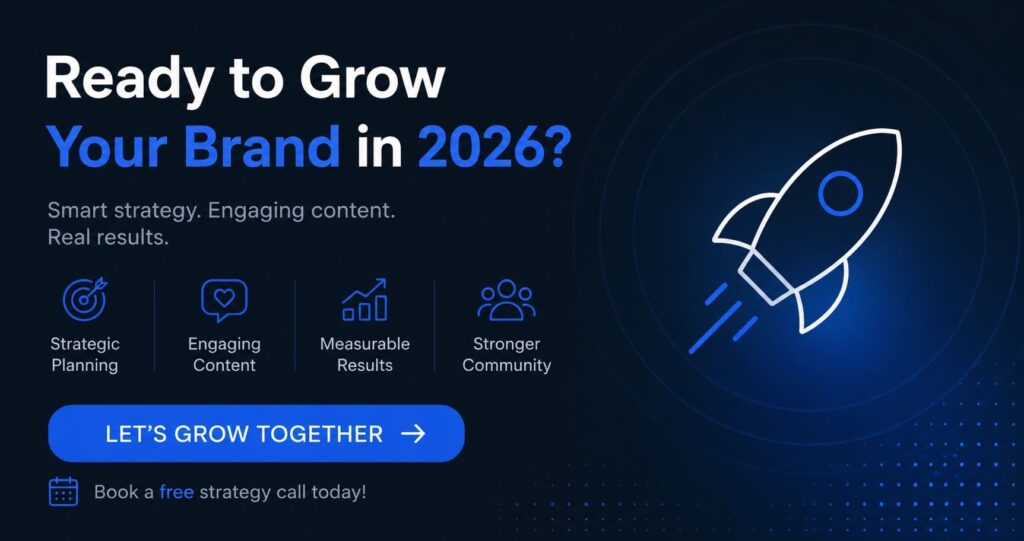
- Define your goals and budget before reaching out — be specific about what success looks like in measurable terms.
- Shortlist 3–5 agencies and put them through the same discovery call format for an honest comparison.
- Request a strategy proposal for a real challenge you are facing — not a generic pitch deck.
- Check reviews on independent platforms like Google, Clutch, or G2 — not just testimonials on their own website.
- Speak with at least one current or former client before finalizing — ask about communication, not just results.
- Negotiate the first 90 days as a structured pilot with clear milestones — a confident agency will welcome this.
- Get everything in writing: deliverables, timelines, ownership of assets, and exit terms.
Common Mistakes Businesses Make When Hiring a Digital Marketing Agency
- Choosing on price alone: The cheapest agency rarely delivers the best results, and recovery costs often exceed the original savings.
- Not defining success upfront: Agencies can only optimize toward a goal that has been clearly communicated to them.
- Ignoring who is behind the pitch: The senior strategist who presents may not be the person who manages your account daily.
- Skipping the contract review: Exit terms, ownership clauses, and payment conditions are frequently buried in standard agency contracts.
- Expecting immediate SEO results: Businesses that cancel at month two typically lose the foundational progress already built.
- Treating the agency as a vendor, not a partner: Agencies perform best when clients share business context, customer feedback, and honest performance assessments.
Is Hiring a Digital Marketing Agency Worth It in 2026?
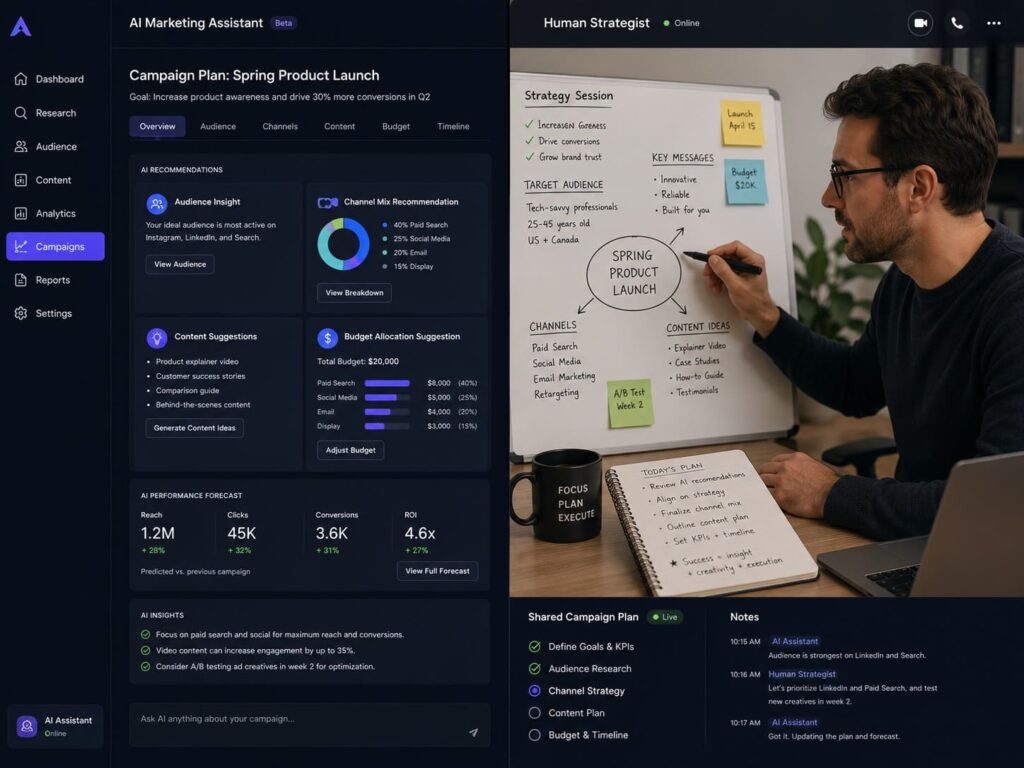
The role of digital marketing agencies is shifting significantly. AI tools are handling first drafts, basic ad creative, and routine keyword research — which means agencies that only offered execution are being commoditized. The agencies that will lead in 2026 are those that offer strategic thinking, audience intelligence, and the ability to translate data into decisions.
Ask any prospective agency: “How are you using AI in your workflow, and where does human strategy still lead?” The answer will tell you whether they are adapting AI thoughtfully or simply automating the tasks. Look for agencies that are also building for AI search visibility — structuring content to appear in Google AI Overviews, Perplexity, ChatGPT Browse, and Gemini — because these surfaces are increasingly where buyers discover services.
Conclusion
Hiring a digital marketing agency is one of the most consequential business decisions you can make. The difference between a good agency and the right one is not visible in a portfolio — it surfaces in how they think, how they communicate, and how honest they are when results fall short of expectations.
Ask the right questions to ask before hiring a digital marketing agency and evaluate the answers carefully, and audit your own readiness as a client. That diligence is what separates businesses that grow with their agencies from those who spend six months recovering from a poor hire.
About The Author
Hemanshi Parekh
Hemanshi Parekh is a digital marketing enthusiast passionate about helping businesses grow through SEO, content marketing, social media strategies, and performance-driven campaigns. With a strong interest in evolving digital trends, Hemanshi creates insightful, practical, and research-backed content that helps readers understand modern marketing strategies in a simple and actionable way.
FAQ
Ask the agency to explain their process from the initial brief to campaign launch. This helps you understand whether they take time to learn about your business before using your budget and whether they follow a clear marketing strategy instead of making reactive campaign decisions.
Request a sample marketing report with confidential information removed. Focus on business metrics like cost per lead, conversion rate, ROAS, and revenue attribution. If the report mainly highlights impressions, reach, or follower growth, the agency may prioritize vanity metrics instead of results that directly support business growth.
Warning signs include promises of instant results, unclear marketing strategies, aggressive sales tactics, hidden pricing structures, failure to provide real campaign performance data, and contracts without clear ownership terms for advertising accounts, creative assets, or collected customer data.
Yes, when selected carefully. The right digital marketing agency gives businesses access to expertise in paid advertising, SEO, content marketing, and social media without the high cost of building an in-house team. Success depends on choosing an agency with relevant experience, transparent reporting, and pricing aligned with your business budget and goals.
You should always own your digital marketing assets, including Google Ads accounts, Meta Business Manager access, website files, and creative materials. A reliable agency operates within accounts owned by your business. Maintaining ownership prevents loss of valuable data, campaign history, and assets if the agency relationship eventually ends.
Paid advertising usually generates initial performance data within 2–4 weeks, while meaningful ROAS often appears after 6–8 weeks of optimization. SEO commonly takes 3–6 months to deliver noticeable organic growth. Content marketing is a long-term strategy that typically builds measurable results over 6–12 months of consistent execution.
Before meeting a digital marketing agency, prepare a clear business goal, realistic budget range, access to existing marketing data, brand guidelines, and audience insights. Also bring questions about the agency’s team structure, campaign process, reporting methods, communication style, pricing transparency, and contract terms to evaluate their suitability properly.