
Digital marketing in political campaigns has transformed the way political campaigns have always been communication exercises. The candidate who reaches more voters with a more persuasive message wins. What has changed profoundly in the past fifteen years is the infrastructure through which that communication happens — and digital marketing in political campaigns now sits at the center of that infrastructure for campaigns at every level, from local council races to large-scale social media and elections campaigns.
The shift is not simply about moving campaign budgets from television to Facebook, but about understanding the importance of digital marketing for politics. Digital marketing in politics enables things that traditional media never could: precise targeting of voter segments through political campaign digital advertising, real-time feedback powered by data analytics in political campaigns, direct fundraising without intermediaries, rapid response to opposition attacks, and the ability to organize volunteers and mobilize supporters through social media political campaigns strategy without proportional increases in staff cost. Modern Digital Marketing Agency understands how political campaigns use digital marketing to build influence, shape public perception, and drive voter engagement at scale.
This article explains how political campaigns use digital marketing, why it has become strategically indispensable, which digital channels produce the strongest political campaign digital advertising results, and what the most successful campaigns have done differently from those that treated digital as an afterthought. It also addresses the ethical dimensions that make political digital marketing a fundamentally different discipline from commercial marketing — and one that comes with responsibilities that campaigns, platforms, and voters are still working out. Whether you are a campaign professional, a political science researcher, or a citizen trying to understand how modern elections are contested, this is the framework that matters.
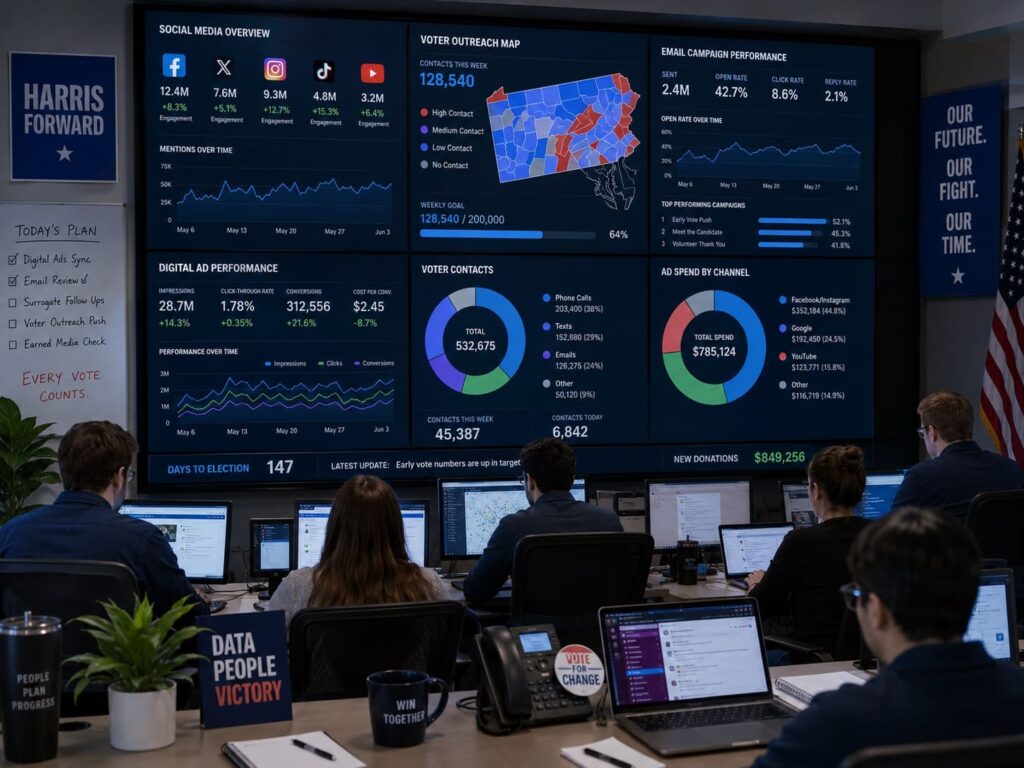
Table of Contents
ToggleWhy Digital Marketing in Political Campaigns Changed Political Campaigning Permanently
Before digital, political campaigns operated on a broadcast model. They bought television and radio time, placed newspaper ads, mailed literature to registered voter households, and organized local volunteers to knock on doors. The feedback loop was slow — you could not know whether a television ad changed voter sentiment until weeks later in polling data, by which time the campaign had already spent the budget.
How political campaigns use digital marketing has changed this in four structural ways. First, it collapsed the cost of reaching voters. A campaign can now use political campaign digital advertising to target and reach a specific demographic in a specific congressional district with a video message for a fraction of what a single television spot would cost, with precise targeting supported by data analytics in political campaigns that broadcast media cannot offer.
Second, it made feedback real-time. A campaign using digital marketing in political campaigns can launch three versions of an ad at 9am, know which is outperforming by noon, and shift the entire budget to the winning variant by afternoon — an optimization cycle that would have taken weeks in a broadcast model.
Third, it enabled direct relationships at scale. Email marketing for political campaigns and social media followings allow campaigns to communicate with supporters without media intermediaries. A candidate who builds an email list of 500,000 engaged supporters has a direct communication channel to half a million people that no newspaper or television station controls.
Fourth, it democratized competitive access. A city council candidate in 2026 has access to the same Facebook Ads Manager, Google Ads, email marketing for political campaigns platforms, and voter outreach tools as a presidential campaign. The absolute spend levels differ, but the strategic capabilities are the same. Digital marketing in political campaigns — often supported by an experienced Digital Marketing Agency — has reduced the structural advantage that incumbents and well-funded candidates previously held through superior media buying power.
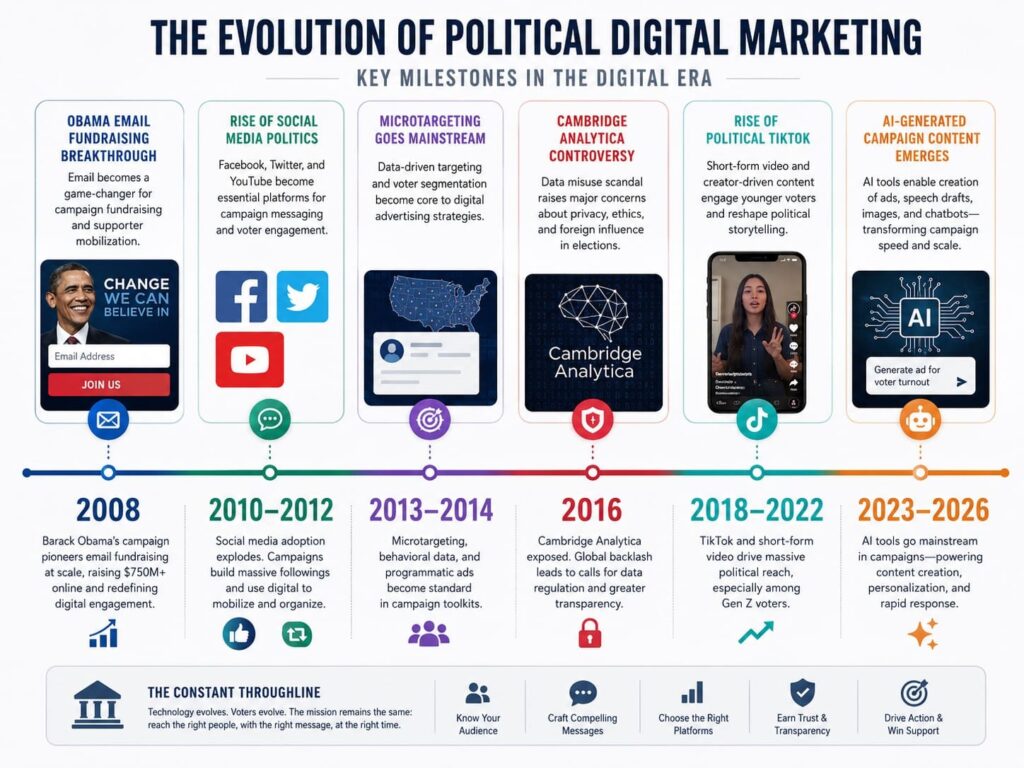
The Landmark Campaigns That Defined Digital Marketing in Political Campaigns
Campaign | Year | Key Digital Innovation | Outcome & Impact |
Barack Obama for President | 2008 | Email fundraising at scale; MyBarackObama.com social platform; data-driven voter contact | Raised $500M+ online; built 13M email list; defined the modern digital campaign model |
Barack Obama for President | 2012 | Predictive voter analytics; A/B testing of every digital touchpoint; social media integration | Analytics team ran 66,000 simulations per night; digital identified 15% more persuadable voters |
Donald Trump for President | 2016 | Organic social media provocation; Facebook dark post micro-targeting; earned media amplification | Cambridge Analytica data controversy; $1B+ in earned media value from social virality |
Alexandria Ocasio-Cortez | 2018 | Authentic Instagram presence; grassroots digital organizing; zero traditional media budget | Defeated 10-term incumbent; demonstrated digital-only campaign viability at congressional level |
Joe Biden for President | 2020 | Digital organizing during pandemic; SMS-to-vote programs; record small-dollar fundraising | Raised $1B online; highest voter turnout in 120 years partly attributed to digital mobilization |
Narendra Modi / BJP | 2014–2024 | WhatsApp network organizing; YouTube content dominance; regional language targeting | Built world’s largest political social media following; redefined political digital in emerging markets |
The through-line across all these landmark campaigns is that digital marketing success in political campaigns is not just about spending more on digital channels. It is about building genuine audience relationships, using data analytics in political campaigns to identify and reach the voters who can actually be moved, and treating every digital touchpoint as an opportunity to deepen engagement rather than broadcast a message.
WhatsApp, Telegram, and Signal-based political organizing networks — particularly influential in India, Brazil, and other global markets with high messaging app penetration — represent a form of digital political communication that is largely invisible to campaign analytics and outside the reach of current advertising regulations. Understanding and ethically engaging with these networks is an emerging frontier in global political digital strategy.
Key Channels in Digital Marketing in Political Campaigns
How political campaigns use digital marketing differs significantly from how commercial brands use digital channels, with different objectives, constraints, and audience expectations. Understanding which channels support a stronger social media political campaigns strategy is essential for building an effective digital strategy.
Channel | Primary Campaign Function | Key Advantage | Key Constraint |
Email Marketing | Fundraising, volunteer mobilization, voter information | Highest ROI; direct ownership of audience; no algorithm dependency | Deliverability management; list decay; requires permission-based building |
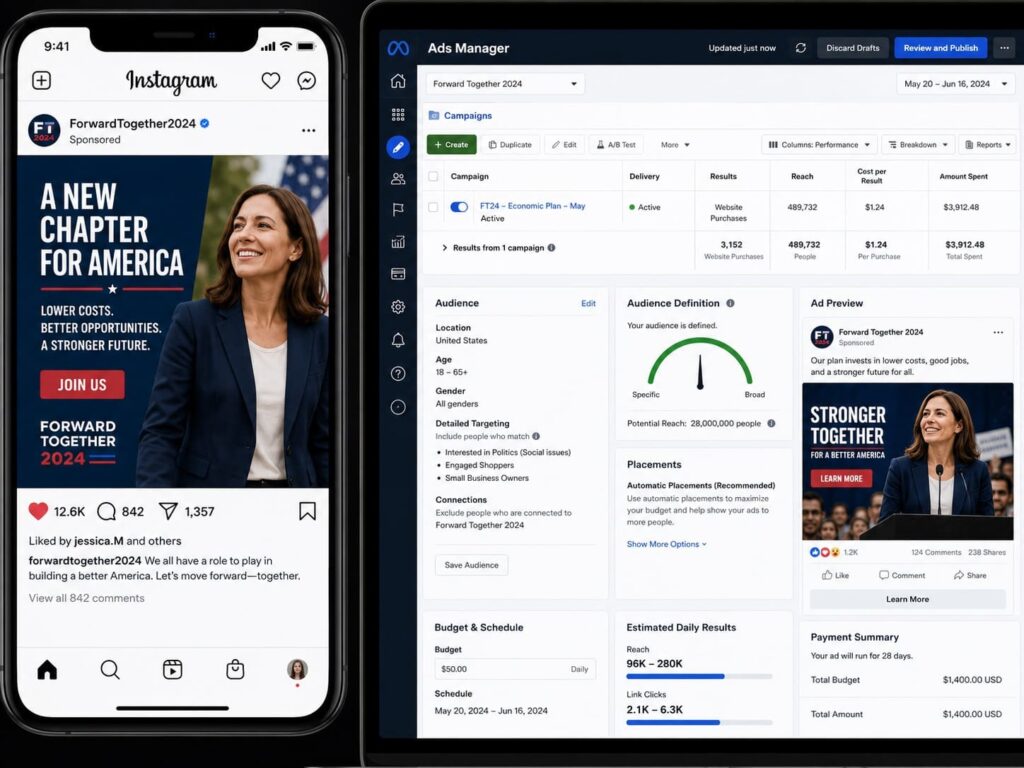
Political campaign digital advertising on Facebook / Instagram | Political campaign digital advertising, persuasion ads, and get-out-the-vote outreach | Granular demographic and behavioral targeting; large reach | Platform ad policies restrict political targeting options; brand safety risks |
YouTube Pre-Roll Ads | Message delivery to voters beyond social media and elections conversations; attack and contrast ads | Non-skippable ad formats; long-form message capability; search intent alignment | Higher CPM than social; limited targeting precision |
Digital political advertising via Google Search Ads | Capturing voters actively searching for candidate information through digital marketing in political campaigns | High-intent audience; dominates SERP above organic results | Political ad verification requirements; restricted in some jurisdictions |
TikTok / Short-Form Video | Reaching younger voters through influencer marketing in politics and short-form content | Organic reach potential; Gen Z dominant; authentic format favored | Ad restrictions on political content; platform ownership controversy |
SMS / Text Messaging | Voter contact, GOTV reminders, fundraising asks | High open rates (95%+); direct delivery; effective for time-sensitive mobilization | Opt-in requirements; spam regulations vary by country; carrier filtering |
SEO and digital marketing in political campaigns | Credibility anchor; donation processing; volunteer signup; policy information | Owned channel; controls the authoritative source of candidate information | Requires SEO investment to rank above opposition and misinformation |
Data Analytics in Political Campaigns: How Campaigns Know What to Say to Whom
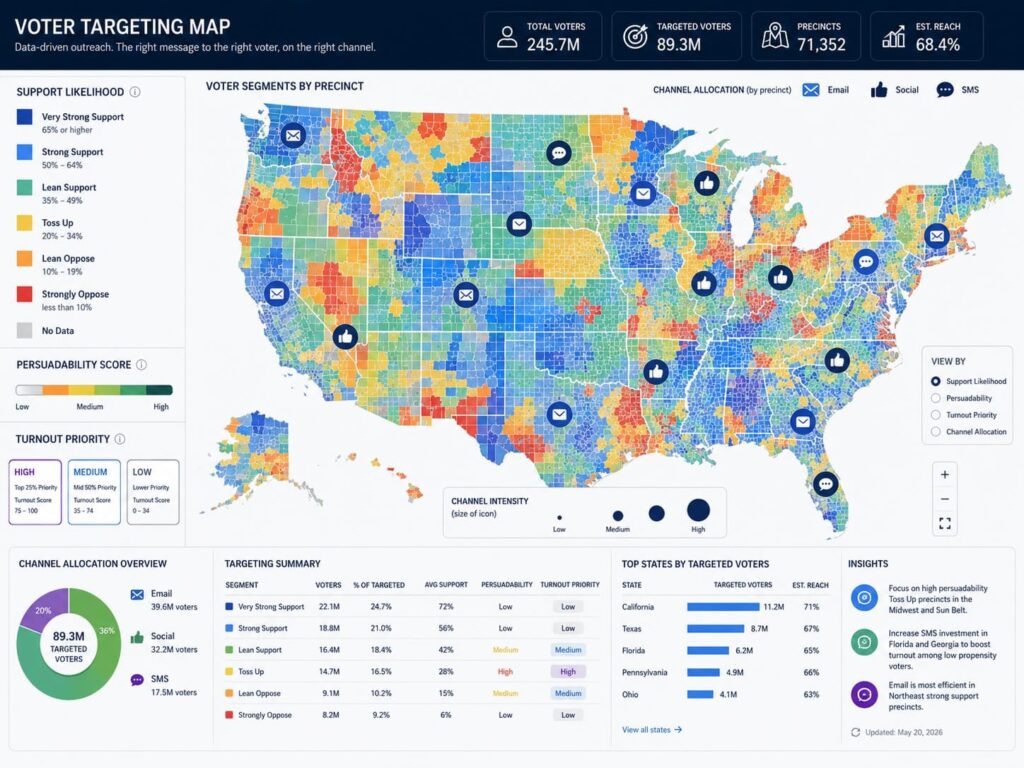
Voter targeting is the capability that most fundamentally separates digital marketing in political campaigns from everything that came before it. In the broadcast era, a campaign running a television ad reached everyone watching that channel at that time — supporters, opponents, and indifferent citizens alike. Modern digital targeting allows a campaign to show a specific economic message to union households in swing precincts who voted in the last primary but not the general election, while simultaneously showing a healthcare message to suburban women who have searched for related terms online.
The data analytics in political campaigns infrastructure enabling this targeting is substantial. Voter files — maintained by state and local election authorities and enriched by party data vendors — contain registration status, voting history, and party affiliation for every registered voter. Commercial data brokers append consumer behavior data for better data analytics in political campaigns: magazine subscriptions, retail purchase history, car registrations, and neighborhood demographics. Digital marketing in political campaigns then layers behavioral signals on top: which website content a voter has viewed, which emails they have opened, and how they have engaged with similar content on social platforms
How Voter Data Flows Into a Digital Campaign
- Voter file acquisition: campaigns obtain state voter files and party-enhanced voter data from vendors like Catalist (Democrat-aligned) or i360 (Republican-aligned)
- Data enrichment: commercial consumer data is appended to voter records to build more complete behavioral profiles
- Predictive modeling: statistical models assign each voter a probability score for support, persuadability, and turnout likelihood
- Audience segmentation: voters are grouped into segments based on scores and issue priorities — ‘soft supporters who need turnout reminders’, ‘persuadable independents’, ‘opposition partisans to de-prioritize’
- Digital activation: voter segments are uploaded to ad platforms as custom audiences, enabling political campaign digital advertising with segment-specific messaging
- Performance feedback: ad engagement data flows back into the model, refining targeting in real time based on which messages generate the strongest responses from which segments
The ethical dimension of voter targeting is significant and cannot be treated as peripheral. The same capability that allows a campaign to deliver a highly relevant policy message to a persuadable voter can be used to deliver misleading messages to isolated demographic groups, or to suppress turnout among opposition voters through fear-based messaging. These uses are neither purely hypothetical nor purely historical — they have occurred in documented campaigns. Understanding voter targeting requires honest engagement with both its legitimate strategic applications and its potential for misuse.
WhatsApp, Telegram, and Signal-based political organizing networks — particularly influential in India, Brazil, and other global markets with high messaging app penetration — represent a form of digital political communication that is largely invisible to campaign analytics and outside the reach of current advertising regulations. Understanding and ethically engaging with these networks is an emerging frontier in global political digital strategy.
Email marketing for political campaigns: Still the Highest-ROI Channel in Politics
While social media captures more attention in coverage of social media political campaigns strategy, email marketing for political campaigns remains the channel where campaigns raise the most money and mobilize the most volunteers per dollar spent. This has been consistently true across the Obama, Sanders, Trump, and Biden campaigns — and it remains true for down-ballot campaigns with modest budgets.
The reason email outperforms other channels in political fundraising is structural. Email reaches people who have already expressed interest in the candidate or cause. The audience is warm. The message arrives in an environment the recipient controls, without competition from other content in a feed. And email allows for a level of personalization and urgency signaling — deadline appeals, matching gift windows, real-time donation counters — that many social media political campaigns strategy formats cannot replicate as effectively.
Bernie Sanders’ 2016 and 2020 campaigns are the most instructive case studies in modern political email marketing. The average donation to the Sanders 2016 campaign was $27. The campaign sent high volumes of personal, urgent, plaintext-style emails that consistently outperformed visually polished HTML templates. The lesson was not that plain text beats good design universally — it was that authenticity and relevance matter more than production value, and that aggressive segmentation and A/B testing on subject lines and call-to-action wording can produce dramatically different results from the same underlying list.
Email Marketing Principles That Work in Political Campaigns
- Subject lines drive open rates more than any other variable — test three to five variations per send before rolling out to the full list
- Urgency and specificity outperform generic appeals: ‘We are $47,000 short of our midnight deadline’ outperforms ‘Help us reach our goal’
- Personalization beyond the first name — referencing the recipient’s state, congressional district, or previous donation amount — increases both open rates and conversion
- List hygiene matters as much as list size: a 100,000-person list with 40% engagement outperforms a 500,000-person list with 5% engagement on both fundraising and deliverability metrics
- Re-engagement sequences for inactive subscribers can recover 10–20% of a lapsed list before it is suppressed, preserving list size while maintaining deliverability metrics
Social Media Political Campaigns Strategy: Organic Reach and Paid Amplification
Social media and elections are closely linked because social media serves two distinct functions in political campaigns: organic presence, which builds the candidate’s public narrative and identity over time, and paid advertising, which delivers targeted messages to specific voter segments. The most effective campaigns treat these as complementary rather than interchangeable.
Organic Social Media
Organic social media reach has declined significantly on Facebook and Instagram over the past several years, as platform algorithms have deprioritized non-paid content. But for political campaigns, organic social still serves functions that paid cannot replicate: building a candidate’s authentic voice, demonstrating grassroots support through engagement, generating earned media when posts go viral, and creating the social proof that strengthens social media political campaigns strategy.
The candidates building the strongest organic social presence in 2026 are those treating their social channels as genuine communication tools rather than broadcast platforms. Behind-the-scenes content, direct-to-camera responses to news events, authentic expressions of policy passion, and genuine engagement with supporter comments consistently outperform polished campaign imagery. Voters are attuned to authenticity on social media in a way that does not apply to the same degree in television or print advertising.
Paid Social Media Advertising
Political campaign digital advertising on social platforms is more constrained than it was five years ago. Meta requires political advertisers to verify their identity and disclose who paid for each ad. Google limits demographic targeting for political ads. TikTok prohibits certain forms of political campaign digital advertising entirely in many markets. These restrictions shape but do not eliminate the strategic value of paid social.
Within the permitted formats, paid social media is most effective for get-out-the-vote (GOTV) efforts in the final weeks of a campaign, for digital fundraising appeals to warm audiences, and for persuasion advertising targeting specific demographic groups on specific issues. The targeting precision available even under current digital political advertising regulations is significantly superior to any traditional media option.
WhatsApp, Telegram, and Signal-based political organizing networks — particularly influential in India, Brazil, and other global markets with high messaging app penetration — represent a form of digital political communication that is largely invisible to campaign analytics and outside the reach of current advertising regulations. Understanding and ethically engaging with these networks is an emerging frontier in global political digital strategy.
Search Engine Optimization, Digital Marketing in Political Campaigns, and Candidate Visibility
Political candidates and campaigns have an underappreciated SEO challenge: when voters search for information about a candidate, they are often served a mix of official campaign content, opposition research, news coverage, and — in contested races — deliberate disinformation. The campaign’s SEO strategy determines whether its own authoritative content or someone else’s narrative appears first in digital marketing in political campaigns.
For well-funded campaigns, this means investing in a campaign website that is technically sound, content-rich, and structured to rank for the candidate’s name and key policy positions. For down-ballot candidates with limited resources, it means at minimum ensuring their official website is indexed correctly, their Google Business Profile is claimed and accurate, and their Wikipedia presence reflects accurate information.
Digital marketing in political campaigns is also highly relevant for issue-based campaigns. Ballot initiatives, referenda, and advocacy campaigns compete in search results against well-funded opposition campaigns, often with significant SEO investment on both sides. The campaign that provides more thorough, authoritative, and well-structured information on a contested issue tends to rank better — which is why political SEO strategy increasingly mirrors the E-E-A-T standards that Google applies to commercial and editorial content.
AI, Data Analytics in Political Campaigns, and Emerging Digital Tools
AI Application | Campaign Use Case | Benefit | Risk |
Large language models (LLMs) | Ad copy generation; email subject line testing; policy position drafting | Dramatically faster content production; more variants tested per budget | Generic output; brand voice inconsistency; potential for misleading framing |
Sentiment analysis | Real-time monitoring of voter reaction to candidate statements and policy positions | Faster message adjustment; early warning on emerging controversies | Sentiment models may misread political sarcasm or regional dialect |
Predictive modeling | Voter turnout prediction; persuasion score modeling; donation likelihood scoring | More precise resource allocation; better targeting efficiency | Model bias from historical data can encode demographic inequities |
Conversational AI / Chatbots | Voter Q&A on website and social; volunteer coordination; event registration | Scale voter contact without proportional staff increase | Accuracy risks on policy positions; legal questions on disclosure requirements |
Synthetic media (deepfakes) | Unauthorized use: fake candidate statements; false endorsements | N/A for legitimate use | Severe integrity risk; several jurisdictions now have laws against political deepfakes |
AI-generated political ads | Automated creative generation for rapid testing | Lower creative production cost; faster iteration | Synthetic content disclosure requirements; audience trust erosion |
The regulatory environment around AI in political campaigning and digital political advertising regulations is developing faster than the technology itself. Several US states, the European Union, and individual social media platforms have implemented or are implementing requirements for disclosure of AI-generated content in political advertising. Campaigns using AI tools for content production need to monitor these requirements carefully — failure to disclose AI-generated political content is not just an ethical concern, it is increasingly a legal one.
AI and Emerging Technologies in Political Campaigning
AI Application | Campaign Use Case | Benefit | Risk |
Large language models (LLMs) | Ad copy generation; email subject line testing; policy position drafting | Dramatically faster content production; more variants tested per budget | Generic output; brand voice inconsistency; potential for misleading framing |
Sentiment analysis | Real-time monitoring of voter reaction to candidate statements and policy positions | Faster message adjustment; early warning on emerging controversies | Sentiment models may misread political sarcasm or regional dialect |
Predictive modeling | Voter turnout prediction; persuasion score modeling; donation likelihood scoring | More precise resource allocation; better targeting efficiency | Model bias from historical data can encode demographic inequities |
Conversational AI / Chatbots | Voter Q&A on website and social; volunteer coordination; event registration | Scale voter contact without proportional staff increase | Accuracy risks on policy positions; legal questions on disclosure requirements |
Synthetic media (deepfakes) | Unauthorized use: fake candidate statements; false endorsements | N/A for legitimate use | Severe integrity risk; several jurisdictions now have laws against political deepfakes |
AI-generated political ads | Automated creative generation for rapid testing | Lower creative production cost; faster iteration | Synthetic content disclosure requirements; audience trust erosion |
The regulatory environment around AI in political campaigning is developing faster than the technology itself. Several US states, the European Union, and individual social media platforms have implemented or are implementing requirements for disclosure of AI-generated content in political advertising. Campaigns using AI tools for content production need to monitor these requirements carefully — failure to disclose AI-generated political content is not just an ethical concern, it is increasingly a legal one.
Ethical and Regulatory Dimensions of Digital Marketing in Political Campaigns
Political digital marketing operates in a distinct ethical context that does not apply to commercial marketing. The goal of a product campaign is to sell a product; the goal of a political campaign is to influence how citizens exercise their democratic rights. That distinction carries responsibilities that the most sophisticated political practitioners take seriously — and that, historically, some have ignored.
The Micro-Targeting Debate
Voter micro-targeting is the most contested practice in political digital marketing. Proponents argue that targeted messaging is simply more efficient communication — delivering relevant information to people who care about specific issues. Critics argue that the same capability enables campaigns to deliver different, potentially contradictory messages to different voter groups without any of them having visibility into what other voters are being told. The Cambridge Analytica scandal brought this debate to mainstream public attention in 2018, though the practice itself predates that controversy by at least a decade.
Platform Advertising Restrictions
Social media platforms have responded to controversy over political advertising with a patchwork of digital political advertising regulations that vary by platform, jurisdiction, and election cycle. Meta requires political ad verification and ad archive access. Google limits political ad targeting. Twitter / X removed political ad restrictions under new ownership and then reimposed some. TikTok bans paid political advertising in most markets. These restrictions are inconsistent across platforms, frequently updated, and difficult for campaigns — particularly at the state and local level — to navigate without specialist expertise.
Disinformation and Campaign Responsibility
Digital marketing channels used by political campaigns for legitimate outreach are the same channels through which social media and elections are also shaped by disinformation. Campaigns have both a legal obligation and a democratic responsibility to distinguish between aggressive but truthful opposition research and fabricated or misleading content. The speed of digital media makes this harder — a false claim shared widely on social media can reach millions of voters before it is corrected, and corrections rarely spread with the same velocity as the original false content.
Challenges Campaigns Face in Digital Execution
Even well-funded and strategically sophisticated campaigns face consistent execution challenges in digital marketing that are worth acknowledging honestly.
- Platform policy volatility: ad policies change frequently and without adequate notice, and campaigns that depend on a single platform for voter contact are exposed to sudden disruption
- Data quality degradation: voter files are never fully current; people move, die, or change registration status, and the quality of targeting models degrades as data ages
- Message discipline at scale: when multiple campaign staff and volunteers are producing digital content simultaneously, maintaining consistent message discipline across channels is genuinely difficult
- Attribution in a multi-channel campaign: a voter who receives an email, sees a Facebook ad, and then searches for the candidate on Google before donating illustrates why attributing campaign outcomes to specific channels is analytically complex
- Digital divide considerations: campaigns that rely exclusively on digital channels systematically underreach older voters, rural voters, and lower-income voters who are less active on digital platforms — a significant strategic and demographic concern
- Security and cyber threats: political campaigns are high-value targets for hacking, doxxing, and coordinated disinformation campaigns; digital security is an operational requirement, not just a technical concern
Best Practices for Digital Marketing in Political Campaigns and Voter Engagement
Build for Owned Channels First
The most durable digital asset a political campaign can build is an email list of engaged supporters, especially when supported by email marketing for political campaigns. Social media followers are borrowed audiences — platform algorithm changes and ad policy shifts can reduce their value overnight. Email subscribers are a direct communication channel the campaign controls. Every other digital channel should funnel toward email capture as the primary conversion objective.
Integrate Digital With Ground Game
The most effective political campaigns treat digital marketing in political campaigns as an amplifier of human organizing, not a replacement for it. Digital tools identify persuadable voters; field organizers have the conversations that move them. Email and text message reminders increase turnout among voters already identified as supporters; the identification itself requires data that comes from door-knocking, phone banking, and direct community presence. Digital-only campaigns consistently underperform campaigns that use digital to support and extend in-person organizing.
Test Everything
Political campaigns operate on short timelines with high stakes — there is rarely a second chance to optimize. A/B testing every major digital touchpoint — email subject lines, ad creative, donation ask amounts, landing page design — is not optional. Campaigns that commit budget to untested creative are leaving performance on the table in a context where a few percentage points of additional fundraising efficiency or voter turnout can determine the outcome.
Maintain Transparency and Accuracy
Beyond regulatory requirements, transparency and accuracy in digital political content are strategic imperatives. Voters have become more sophisticated at identifying misleading or manipulative content, and campaigns caught in factual inaccuracies pay reputational costs that are amplified rather than contained by digital media. This applies with particular force to AI-generated content, which audiences are increasingly trained to scrutinize.
Respect Regulatory Frameworks
Campaign finance disclosure requirements for digital advertising, ad archive obligations, political advertising verification requirements, and emerging AI content disclosure laws vary significantly by jurisdiction. Campaigns operating without specialist compliance oversight in this area are taking regulatory risk that can result in fines, negative earned media, and damage to the candidate’s credibility.
Common Mistakes in Digital Marketing in Political Campaigns
Mistake | Why It Happens | Consequence |
Treating digital as an afterthought until the final weeks | Campaign timelines prioritize early traditional outreach; digital seen as supplementary | Email list too small to matter; no audience to activate for GOTV; missed fundraising |
Chasing social media followers over email subscribers | Follower counts are public and feel like a measure of support; email is invisible | Platform algorithm dependency; no owned audience for the most critical campaign moments |
Running undifferentiated messaging to all voters | Message discipline mistaken for message uniformity; targeting perceived as complex | Persuadable voters receive messages designed for strong supporters; conversion is lower |
Ignoring negative search results | Campaigns focus on publishing positive content; defensive SEO feels reactive | Opposition or disinformation content ranks first; shapes undecided voter perceptions |
Failing to disclose AI-generated content | Compliance teams not tracking AI disclosure requirements; treated as optional | Legal liability; earned media controversy; voter trust damage |
No digital crisis communication protocol | Crisis seems unlikely until it happens; protocol development is deprioritized | Slow response amplifies controversy; initial framing set by opponents or media |
Future Outlook: Where Digital Marketing in Political Campaigns Is Heading
Several developments currently in early deployment will become standard practice in political campaigns over the next election cycle.
AI-Powered Real-Time Message Optimization
Campaigns are beginning to use AI to analyze which specific message framings perform best with specific voter segments in real time, adjusting paid media content within the same news cycle based on engagement signals. This compresses the message optimization cycle from weeks to hours and will become standard practice in well-funded campaigns within the next two election cycles.
Regulatory Tightening Around Digital Political Advertising
The regulatory environment for digital political advertising is moving in the direction of greater transparency and disclosure requirements globally. The European Union’s Digital Services Act imposes new obligations on platforms around political advertising. US states are implementing AI content disclosure requirements. Campaigns that build compliance infrastructure proactively will be better positioned than those that treat regulation as a constraint to navigate around.
The Declining Effectiveness of Hyper-Targeting
There is growing evidence that the micro-targeting advantage in digital political advertising is declining as voters become more aware that their information environment is curated and campaigns become more cautious about the regulatory and reputational risks of granular targeting. Broad-reach digital video advertising that combines emotional resonance with authentic candidate presentation is showing stronger results in some recent campaigns than highly granular demographic targeting.
Decentralized Organizing Through Messaging Apps
WhatsApp, Telegram, and Signal-based political organizing networks — particularly influential in India, Brazil, and other global markets with high messaging app penetration — represent a form of digital political communication that is largely invisible to campaign analytics and outside the reach of current advertising regulations. Understanding and ethically engaging with these networks is an emerging frontier in global political digital strategy.
Conclusion
Digital marketing is not a tactic that political campaigns can choose to adopt or ignore — it is the medium through which modern democratic participation is increasingly organized, fundraised, and contested. Campaigns that treat it as an add-on to traditional strategy consistently underperform those that build digital capability into their campaign architecture from the start.
The principles that make digital marketing effective in political campaigns are the same ones that make it effective in any context: know your audience specifically, deliver relevant messages through channels they trust, test relentlessly, own the relationships you build, and measure what actually matters to your objectives. The political context adds layers of ethical responsibility, regulatory complexity, and democratic accountability that do not apply in commercial marketing — and that serious campaign professionals take seriously.
If your organization, advocacy campaign, or political team needs specialist digital strategy support — from audience building and email program development to digital advertising and SEO — Hawkeye Marketing works at the intersection of digital marketing expertise and communications strategy.
About The Author
Hemanshi Parekh
Hemanshi Parekh is a digital marketing enthusiast passionate about helping businesses grow through SEO, content marketing, social media strategies, and performance-driven campaigns. With a strong interest in evolving digital trends, Hemanshi creates insightful, practical, and research-backed content that helps readers understand modern marketing strategies in a simple and actionable way.
FAQ
Email marketing delivers the highest ROI for political fundraising and volunteer engagement, while paid social media advertising supports voter targeting and persuasion. YouTube ads expand reach beyond social platforms, SMS drives rapid mobilization through high open rates, and search ads capture active voter interest. Successful political campaigns integrate all channels for maximum impact.
Political campaigns build voter targeting models by combining voter records, consumer data, and digital behavior insights. Statistical analysis helps predict voter support, persuasion potential, and turnout likelihood. Campaigns use these scores to create targeted advertising audiences, allowing personalized political messaging for specific voter groups instead of delivering the same message to everyone.
Micro-targeting in political campaigns uses detailed voter data to deliver personalized messages to specific voter groups. Campaigns tailor content based on demographics, interests, or location, ensuring different audiences receive different political messages. Although legal in many regions, the practice raises ethical concerns because campaigns can present conflicting positions to separate voter groups simultaneously.
Barack Obama transformed political digital marketing by proving that large-scale email fundraising, volunteer-driven online communities, and data-focused voter targeting could outperform traditional campaign methods. His 2012 campaign advanced predictive analytics and A/B testing, creating a modern digital campaign strategy that later political campaigns adopted, refined, and expanded worldwide.
Key ethical concerns in political digital marketing include opaque voter micro-targeting, voter suppression through behavioral data, disinformation campaigns, and AI-generated synthetic media spreading false narratives. Concerns also exist about wealthy candidates gaining unfair digital advantages. Although regulations are evolving, enforcement remains inconsistent, and ethical standards vary widely across political campaigns and jurisdictions.